


Page 63 - English Lesson Plan Year 3
P. 63
Primary Year 3 SK Scheme of Work
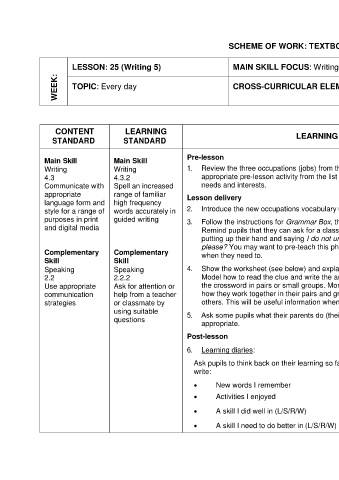
SCHEME OF WORK: TEXTBOOK BASED LESSON (Unit 2)
LESSON: 25 (Writing 5) MAIN SKILL FOCUS: Writing THEME: World of Self, Family and Friends
WEEK: TOPIC: Every day CROSS-CURRICULAR ELEMENT: Language LANGUAGE/GRAMMAR FOCUS: Present simple for
habits/occupations
CONTENT LEARNING MATERIALS / DIFFERENTIATION
STANDARD STANDARD LEARNING OUTLINE REFERENCES STRATEGIES
Main Skill Main Skill Pre-lesson Get Smart plus 3 Differentiate learning
Writing Writing 1. Review the three occupations (jobs) from the previous lesson by choosing an Student’s Book according to the needs
4.3 4.3.2 appropriate pre-lesson activity from the list in the introduction that suits your pupils’ p.19 of your pupils and
Communicate with Spell an increased needs and interests. class. Please see the
appropriate range of familiar Lesson delivery Teacher’s Book seven differentiation
language form and high frequency p.37 strategies listed in the
style for a range of words accurately in 2. Introduce the new occupations vocabulary using flashcards. Flashcards of introduction. Please
purposes in print guided writing 3. Follow the instructions for Grammar Box, then Activity 3 in the Teacher’s Book p.37. occupations also consider the
and digital media Remind pupils that they can ask for a classmate’s help if they can’t read a word by (including those following:
putting up their hand and saying I do not understand this word. Can you help me, in the You could also
please? You may want to pre-teach this phrase. They can also ask you this question worksheet) encourage pupils to use
Complementary Complementary when they need to. a dictionary if
Skill Skill Crossword necessary and
Speaking Speaking 4. Show the worksheet (see below) and explain that pupils will do a crossword puzzle. worksheet (see appropriate if they need
2.2 2.2.2 Model how to read the clue and write the answer in the crossword. Have pupils work on below) extra practice in this.
Use appropriate Ask for attention or the crossword in pairs or small groups. Monitor and help pupils as necessary. Observe
communication help from a teacher how they work together in their pairs and groups to see which pupils are able to support You could put the
strategies or classmate by others. This will be useful information when pairing and grouping pupils in the future. occupations words on
using suitable 5. Ask some pupils what their parents do (their occupations). Extend pupils’ vocabulary as the board for pupils to
questions copy the spelling if
appropriate. necessary.
Post-lesson
6. Learning diaries:
Ask pupils to think back on their learning so far this week. In their learning diary, they can
write:
New words I remember
Activities I enjoyed
A skill I did well in (L/S/R/W)
A skill I need to do better in (L/S/R/W)
61

