


Page 1138 - How to Make Money in Stocks Trilogy
P. 1138
124  HOW TO MAKE MONEY IN STOCKS—GETTING STARTED


                     Important Note About the 20%–25% Rule

         The 20%–25% gain is calculated from the stock’s ideal buy point. That may
         be different from your own purchase price.
           As you’ll see later when we discuss chart patterns, the buying range for a
         stock is from the ideal buy point up to 5% above that. So let’s say you bought
         4% above the ideal buy point. If the stock then rose 20% above the ideal buy
         point, your profit would be 16%.
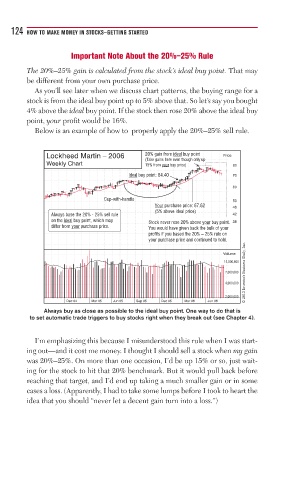
           Below is an example of how to  properly apply the 20%–25% sell rule.


              Lockheed Martin – 2006      20% gain from ideal buy point  Price
                                          (Take gains here even though only up
              Weekly Chart                15% from your buy price)  80
                                     Ideal buy point: 64.40       70

                                                                  60
                              Cup-with-handle                     50
                                            Your purchase price: 67.62  46
                                            (5% above ideal price)
               Always base the 20% - 25% sell rule                42
               on the ideal buy point, which may   Stock never rose 20% above your buy point.    38
               differ from your purchase price.  You would have given back the bulk of your
                                           profits if you based the 20% – 25% rule on
                                           your purchase price and continued to hold.
                                                                Volume
                                                                12,000,000
                                                                7,000,000 © 2013 Investor’s Business Daily, Inc.
                                                                4,000,000

                                                                2,000,000
                    Dec 04  Mar 05  Jun 05  Sep 05  Dec 05  Mar 06  Jun 06
             Always buy as close as possible to the ideal buy point. One way to do that is
         to set automatic trade triggers to buy stocks right when they break out (see Chapter 4).


           I’m emphasizing this because I misunderstood this rule when I was start-
         ing out—and it cost me money. I thought I should sell a stock when my gain
         was 20%–25%. On more than one occasion, I’d be up 15% or so, just wait-
         ing for the stock to hit that 20% benchmark. But it would pull back before
         reaching that target, and I’d end up taking a much smaller gain or in some
         cases a loss. (Apparently, I had to take some lumps before I took to heart the
         idea that you should “never let a decent gain turn into a loss.”)

