


Page 271 - How to Make Money in Stocks Trilogy
P. 271
How to Read Charts Like a Pro and Improve Your Selection and Timing 149


                     Global Crossing                        Price
                                                            100
                     Weekly Chart                           80
                                          D D Do NOT BuyNOT BNOT  y  70
                                                            60
                                                            50
                                                            40
                                                            34
                                                            30
                                                            26
                                                            22
                                              Stock         19
                                              Stock wedges wedgesek we
                                              S
                                              u
                                              up in handle en han  16
                                              along lowsl a  g g l g low
                                                            14
                                                            12
                                                            10
                              2/1
                                                           Volume © 2009 Investor’s Business Daily, Inc.
                                                          80,000,000
                                                          50,000,000
                                                          30,000,000
                                                          18,000,000
                     Dec 1998  Mar 1999  Jun 1999  Sep 1999  Dec 1999  Mar 2000  Jun 2000
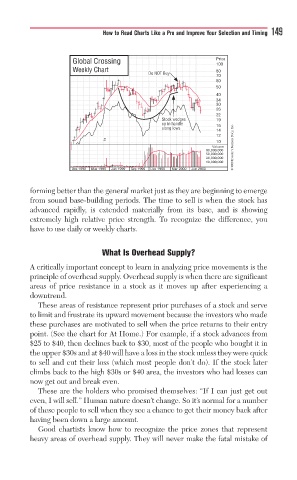
          forming better than the general market just as they are beginning to emerge
          from sound base-building periods. The time to sell is when the stock has
          advanced rapidly, is extended materially from its base, and is showing
          extremely high relative price strength. To recognize the difference, you
          have to use daily or weekly charts.
                             What Is Overhead Supply?

          A critically important concept to learn in analyzing price movements is the
          principle of overhead supply. Overhead supply is when there are significant
          areas of price resistance in a stock as it moves up after experiencing a
          downtrend.
            These areas of resistance represent prior purchases of a stock and serve
          to limit and frustrate its upward movement because the investors who made
          these purchases are motivated to sell when the price returns to their entry
          point. (See the chart for At Home.) For example, if a stock advances from
          $25 to $40, then declines back to $30, most of the people who bought it in
          the upper $30s and at $40 will have a loss in the stock unless they were quick
          to sell and cut their loss (which most people don’t do). If the stock later
          climbs back to the high $30s or $40 area, the investors who had losses can
          now get out and break even.
            These are the holders who promised themselves: “If I can just get out
          even, I will sell.” Human nature doesn’t change. So it’s normal for a number
          of these people to sell when they see a chance to get their money back after
          having been down a large amount.
            Good chartists know how to recognize the price zones that represent
          heavy areas of overhead supply. They will never make the fatal mistake of

