


Page 347 - How to Make Money in Stocks Trilogy
P. 347
M = Market Direction: How You Can Determine It 223


           1998 S&P 500 Market Bottom                                  Index
                                                                       Scale
                                                                       1200
                                            F F Folloolloollol www-throughthroughthroughh  h h h h
                          F Folloooollowww-throughoug-through h h  6th dayyday y y  1150
                                            6th
                          5th  y
                          5th daydaydaa
                          5th
                                                                       1100
                          Day 111a y y
                          D D
                          Day
                                                                       1050
                                          D Day
                                            y y
                                          Day 111
                                          D
                                                                       1000
                                                                        950
                                                                        900
           Daily Chart
                                                                      Volume (00)
          NYSE Volume                                                 10,000,000
                                                                      7,500,000 © 2009 Investor’s Business Daily, Inc.
                                                                      5,000,000
                                                                      2,500,000
              August 1998   September 1998  October 1998  November 1998
           2003 Nasdaq Market Bottom                                   Index
                                                                       Scale
                                                                       1550
                                                                       1500
                                                          F Folloooollooww-throughoug-throughr  h h
                                                          4th
                                                          4th daydayda
                                                          4th  y       1450
                                                                       1400
                                                          Day y y      1350
                                                          Day 11y
                                                                       1300
                                                                       1250
           Daily Chart
          Nasdaq Volume                                              Volume (00)
                                                                      19,600,000
                                                                      14,700,000 © 2009 Investor’s Business Daily, Inc.
                                                                      9,800,000
                                                                      4,900,000
               December 2002  January 2003   February 2003  March 2003
                    The Big Money Is Made in the First Two Years
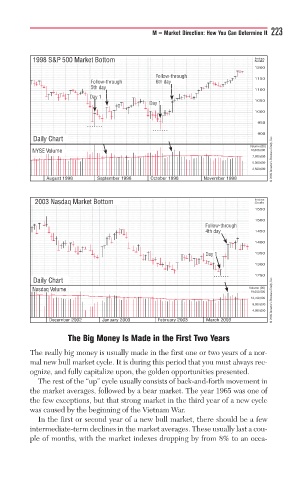
          The really big money is usually made in the first one or two years of a nor-
          mal new bull market cycle. It is during this period that you must always rec-
          ognize, and fully capitalize upon, the golden opportunities presented.
            The rest of the “up” cycle usually consists of back-and-forth movement in
          the market averages, followed by a bear market. The year 1965 was one of
          the few exceptions, but that strong market in the third year of a new cycle
          was caused by the beginning of the Vietnam War.
            In the first or second year of a new bull market, there should be a few
          intermediate-term declines in the market averages. These usually last a cou-
          ple of months, with the market indexes dropping by from 8% to an occa-

