


Page 312 - KSPK ENGLISH LANGUAGE
P. 312
2. Games and game-like activities and the EEE (Encounter, Engage and Exploit) Model
Games and game-like activities play an important role in any Preschool language programme, mainly
because they provide a natural context for communication between adult and child / children and between
the children themselves.
Games are also:
fun and enjoyable and children associate this pleasure and enjoyment with English
often familiar to a group of children. They may know a similar game with the same rules in their
own language
activities that naturally provide an opportunity for relevant and enjoyable repetition
a meaningful context for using English - real intentions, real plans and real strategies. English
becomes a necessary resource to be used for a real purpose
motivating. They involve luck not just proficiency in English and so generate hopes, fears and
excitement
are social activities - they can involve group and pair work thus often involve collaboration, they
also help children understand the concept of winning and losing
a way to develop a child’s cognitive skills, e.g. concentration, memorising, sequencing, eliminating,
comparing, counting, number recognition
excellent as an observation mechanism to expose areas in need of remedial work
are useful for developing fine and gross motor skills.
Categorising games and game-like activities
To use games properly we need to know which to use and when to use them according to the opportunities
and challenges they present preschool children. Thinking about what children are doing during these
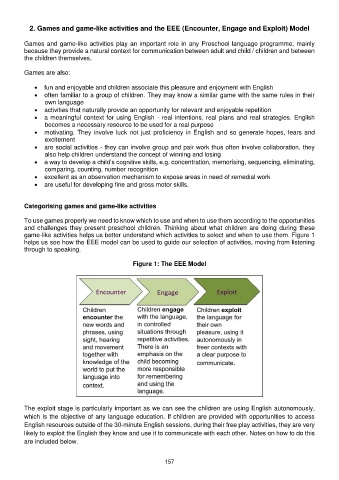
game-like activities helps us better understand which activities to select and when to use them. Figure 1
helps us see how the EEE model can be used to guide our selection of activities, moving from listening
through to speaking.
Figure 1: The EEE Model
The exploit stage is particularly important as we can see the children are using English autonomously,
which is the objective of any language education. If children are provided with opportunities to access
English resources outside of the 30-minute English sessions, during their free play activities, they are very
likely to exploit the English they know and use it to communicate with each other. Notes on how to do this
are included below.
157

