


Page 24 - Learn to Program - Basic-256
P. 24
Chapter 1: Meeting BASIC-256 – Say Hello.                                          Page 8


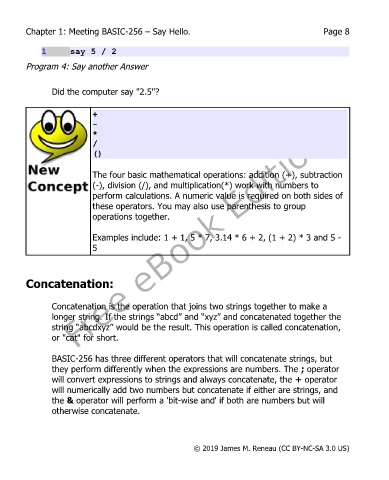
             1      say 5 / 2
        Program 4: Say another Answer


               Did the computer say "2.5"?


                           +
                           -
                           *
                           /
                           ()

                           The four basic mathematical operations: addition (+), subtraction
                           (-), division (/), and multiplication(*) work with numbers to
                           perform calculations. A numeric value is required on both sides of
                           these operators. You may also use parenthesis to group
                           operations together.

                           Examples include: 1 + 1, 5 * 7, 3.14 * 6 + 2, (1 + 2) * 3 and 5 -
                           5


        Concatenation:


               Concatenation is the operation that joins two strings together to make a
               longer string. If the strings “abcd” and “xyz” and concatenated together the
               string “abcdxyz” would be the result. This operation is called concatenation,
               or "cat" for short.

               BASIC-256 has three different operators that will concatenate strings, but
               they perform differently when the expressions are numbers. The ; operator
               will convert expressions to strings and always concatenate, the + operator
               will numerically add two numbers but concatenate if either are strings, and
               the & operator will perform a 'bit-wise and' if both are numbers but will
               otherwise concatenate.


                                                       © 2019 James M. Reneau (CC BY-NC-SA 3.0 US)

