


Page 225 - Programming With Python 3
P. 225
An Introduction to STEM Programming with Python — 2019-09-03a                              Page 212
            Bonus Chapter 1 — Problem Solving

            to solve a problem, not the final implementation.

             Free
            Think of the acronym IDEAL as a way to remember the 5 steps to solving a problem algorithmically.

            I — Identify the problem.
            D — Define and represent the problem.
            E — Explore possible strategies.
            A — Act on your strategy.
             eBook
            L — Look back and evaluate at your solution.


             Edition


            Please support this work at


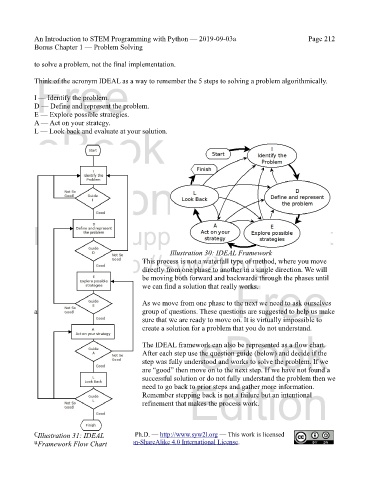
                                                         Illustration 30: IDEAL Framework
                                  http://syw2l.org
                                                This process is not a waterfall type of method, where you move
                                                directly from one phase to another in a single direction. We will
                                                be moving both forward and backwards through the phases until
                                                                               Free
                                                we can find a solution that really works.


                                                As we move from one phase to the next we need to ask ourselves
            a                                   group of questions. These questions are suggested to help us make
                                                sure that we are ready to move on. It is virtually impossible to
                                                create a solution for a problem that you do not understand.
                                                                   eBook
                                                The IDEAL framework can also be represented as a flow chart.
                                                After each step use the question guide (below) and decide if the
                                                step was fully understood and works to solve the problem. If we
                                                are “good” then move on to the next step. If we have not found a
                                                successful solution or do not fully understand the problem then we
                                                                Edition
                                                need to go back to prior steps and gather more information.
                                                Remember stepping back is not a failure but an intentional
                                                refinement that makes the process work.


            Copyright 2019 — James M. Reneau Ph.D. — http://www.syw2l.org — This work is licensed
              Illustration 31: IDEAL
            under a Creative Commons Attribution-ShareAlike 4.0 International License.
              Framework Flow Chart

