


Page 43 - Programming With Python 3
P. 43
An Introduction to STEM Programming with Python — 2019-09-03a                               Page 30
            Chapter 2 — Numbering Systems

                • •  compliment                  • •  positional                  • •  subtraction
                                                     remainder
                    decimal
                                                                                      ten
             Free                                •   sixteen                      •   two
                •
                    hexadecimal
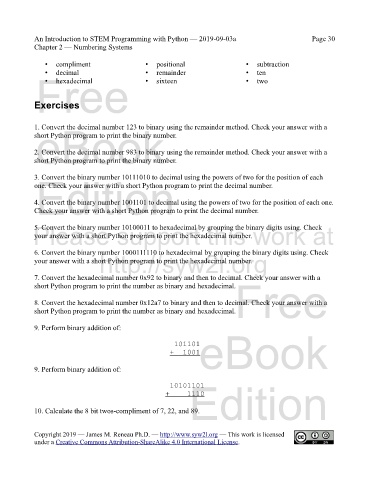
            Exercises


             eBook
            1. Convert the decimal number 123 to binary using the remainder method. Check your answer with a
            short Python program to print the binary number.

            2. Convert the decimal number 983 to binary using the remainder method. Check your answer with a
            short Python program to print the binary number.


            3. Convert the binary number 10111010 to decimal using the powers of two for the position of each
             Edition
            one. Check your answer with a short Python program to print the decimal number.

            4. Convert the binary number 1001101 to decimal using the powers of two for the position of each one.
            Check your answer with a short Python program to print the decimal number.

            Please support this work at
            5. Convert the binary number 10100011 to hexadecimal by grouping the binary digits using. Check
            your answer with a short Python program to print the hexadecimal number.

            6. Convert the binary number 1000111110 to hexadecimal by grouping the binary digits using. Check
                                  http://syw2l.org
            your answer with a short Python program to print the hexadecimal number.

            7. Convert the hexadecimal number 0x92 to binary and then to decimal. Check your answer with a
                                                                               Free
            short Python program to print the number as binary and hexadecimal.


            8. Convert the hexadecimal number 0x12a7 to binary and then to decimal. Check your answer with a
            short Python program to print the number as binary and hexadecimal.


            9. Perform binary addition of:
                                                                   eBook
                                                          101101
                                                         +  1001

            9. Perform binary addition of:

                                                                Edition
                                                         10101101
                                                        +    1110


            10. Calculate the 8 bit twos-compliment of 7, 22, and 89.


            Copyright 2019 — James M. Reneau Ph.D. — http://www.syw2l.org — This work is licensed
            under a Creative Commons Attribution-ShareAlike 4.0 International License.

