


Page 47 - Programming With Python 3
P. 47
An Introduction to STEM Programming with Python — 2019-09-03a                               Page 34
            Chapter 3 — Strings, Input, and Interactive Programs

                    ◦ "how " + "now" evaluates to how now
                    ◦ "abcdef" + "ghij" evaluates to abcdefghij
             Free
                    ◦ "abc'def" + 'ghi"jkl' evaluates to abc'defghi"jlk
                 •
                    * — Repeat (Multiply)
                    ◦ If both are numbers then multiply
                    ◦ if first is a string and second is an integer then repeat the string that many times. if n is <=0
                        then return the empty string.
                    ◦ "a"*10 evaluates to aaaaaaaaaa
             eBook
                    ◦ "cow"*-4 evaluates to "" (the empty string)


             +  *                                                                            String Operators

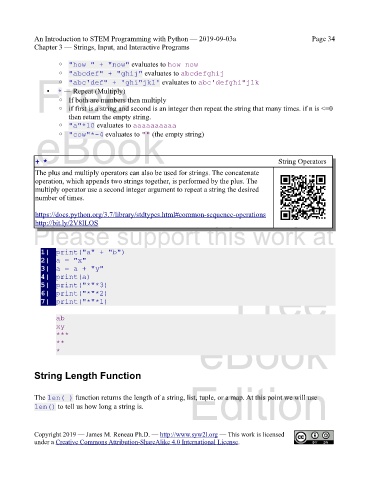
             The plus and multiply operators can also be used for strings. The concatenate
             Edition
             operation, which appends two strings together, is performed by the plus. The
             multiply operator use a second integer argument to repeat a string the desired
             number of times.

             https://docs.python.org/3.7/library/stdtypes.html#common-sequence-operations
             http://bit.ly/2V8ILOS
            Please support this work at


               1|  print("a" + "b")
               2|  a = "x"        http://syw2l.org
               3|  a = a + "y"
               4|  print(a)
               5|  print("*"*3)
               6|  print("*"*2)
               7|  print("*"*1)                                                Free


                    ab
                    xy
                    ***
                    **
                    *                                              eBook


            String Length Function
                                                                Edition

            The len( ) function returns the length of a string, list, tuple, or a map. At this point we will use
            len() to tell us how long a string is.


            Copyright 2019 — James M. Reneau Ph.D. — http://www.syw2l.org — This work is licensed
            under a Creative Commons Attribution-ShareAlike 4.0 International License.

