


Page 44 - Unit2.docx
P. 44
geometry.
4.3.2 Drained load capacity (effective stress approach)
For piles installed in stiff, over consolidated clays, the drained load capacity is
taken as design criterion. If the simplified assumption is made that the drained pile-
soil adhesion C¢ is zero and that the term in eq (4-2)…involving N , Nγ ignoring
c
a
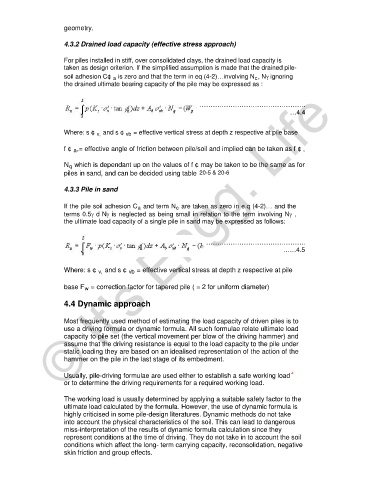
the drained ultimate bearing capacity of the pile may be expressed as :
…………………………………………
…4.4
Where: s ¢ and s ¢ = effective vertical stress at depth z respective at pile base
vb
v,
f ¢ ,= effective angle of friction between pile/soil and implied can be taken as f ¢ ,
a
q
N which is dependant up on the values of f ¢ may be taken to be the same as for
piles in sand, and can be decided using table 20-5 & 20-6
4.3.3 Pile in sand
If the pile soil adhesion C and term N are taken as zero in e.q (4-2)… and the
a
c
terms 0.5γ d Nγ is neglected as being small in relation to the term involving Nγ ,
the ultimate load capacity of a single pile in sand may be expressed as follows:
© It's Engg. Life
………………………………………
……4.5
Where: s ¢ and s ¢ = effective vertical stress at depth z respective at pile
vb
v,
base F = correction factor for tapered pile ( = 2 for uniform diameter)
w
4.4 Dynamic approach
Most frequently used method of estimating the load capacity of driven piles is to
use a driving formula or dynamic formula. All such formulae relate ultimate load
capacity to pile set (the vertical movement per blow of the driving hammer) and
assume that the driving resistance is equal to the load capacity to the pile under
static loading they are based on an idealised representation of the action of the
hammer on the pile in the last stage of its embedment.
Usually, pile-driving formulae are used either to establish a safe working load
or to determine the driving requirements for a required working load.
The working load is usually determined by applying a suitable safety factor to the
ultimate load calculated by the formula. However, the use of dynamic formula is
highly criticised in some pile-design literatures. Dynamic methods do not take
into account the physical characteristics of the soil. This can lead to dangerous
miss-interpretation of the results of dynamic formula calculation since they
represent conditions at the time of driving. They do not take in to account the soil
conditions which affect the long- term carrying capacity, reconsolidation, negative
skin friction and group effects.

