


Page 54 - Unit2.docx
P. 54
cc
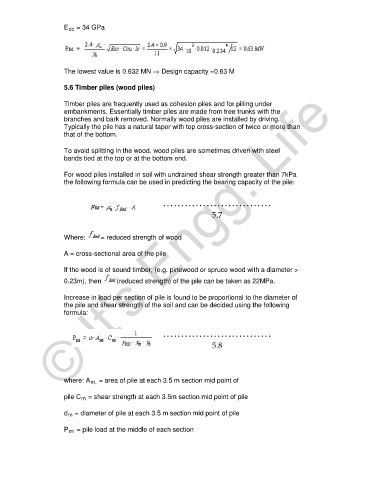
                      E  = 34 GPa


                      The lowest value is 0.632 MN ⇒ Design capacity =0.63 M

                      © It's Engg. Life
                      5.6 Timber piles (wood piles)

                      Timber piles are frequently used as cohesion piles and for pilling under
                      embankments. Essentially timber piles are made from tree trunks with the
                      branches and bark removed. Normally wood piles are installed by driving.
                      Typically the pile has a natural taper with top cross-section of twice or more than
                      that of the bottom.

                      To avoid splitting in the wood, wood piles are sometimes driven with steel
                      bands tied at the top or at the bottom end.

                      For wood piles installed in soil with undrained shear strength greater than 7kPa
                      the following formula can be used in predicting the bearing capacity of the pile:


                                                       …………………………

                                                                       5.7


                      Where:      = reduced strength of wood

                      A = cross-sectional area of the pile

                      If the wood is of sound timber, (e.g. pinewood or spruce wood with a diameter >
                      0.23m), then      (reduced strength) of the pile can be taken as 22MPa.

                      Increase in load per section of pile is found to be proportional to the diameter of
                      the pile and shear strength of the soil and can be decided using the following
                      formula:

                                                       …………………………

                                                                       5.8


                      where: A m,  = area of pile at each 3.5 m section mid point of

                      pile C  = shear strength at each 3.5m section mid point of pile
                            m
                      d  = diameter of pile at each 3.5 m section mid point of pile
                        m

                      P  = pile load at the middle of each section
                        mi

