


Page 52 - Unit2.docx
P. 52
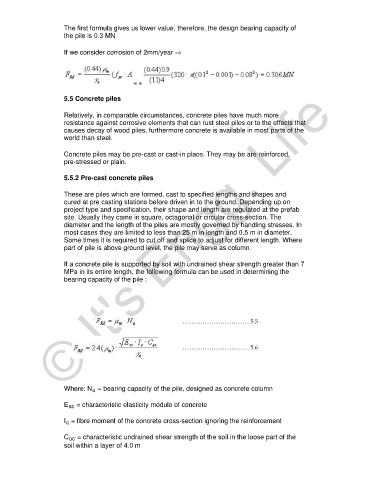
The first formula gives us lower value, therefore, the design bearing capacity of
                      the pile is 0.3 MN

                      If we consider corrosion of 2mm/year ⇒


                      © It's Engg. Life
                                             = =

                      5.5 Concrete piles

                      Relatively, in comparable circumstances, concrete piles have much more
                      resistance against corrosive elements that can rust steel piles or to the effects that
                      causes decay of wood piles, furthermore concrete is available in most parts of the
                      world than steel.

                      Concrete piles may be pre-cast or cast-in place. They may be are reinforced,
                      pre-stressed or plain.

                      5.5.2 Pre-cast concrete piles

                      These are piles which are formed, cast to specified lengths and shapes and
                      cured at pre casting stations before driven in to the ground. Depending up on
                      project type and specification, their shape and length are regulated at the prefab
                      site. Usually they came in square, octagonal or circular cross-section. The
                      diameter and the length of the piles are mostly governed by handling stresses. In
                      most cases they are limited to less than 25 m in length and 0.5 m in diameter.
                      Some times it is required to cut off and splice to adjust for different length. Where
                      part of pile is above ground level, the pile may serve as column.

                      If a concrete pile is supported by soil with undrained shear strength greater than 7
                      MPa in its entire length, the following formula can be used in determining the
                      bearing capacity of the pile :


                                                             ………………………… 5.5


                                                             ………………………… 5.6


                      Where: N  = bearing capacity of the pile, designed as concrete column
                                u

                      E  = characteristic elasticity module of concrete
                        sc

                      I  = fibre moment of the concrete cross-section ignoring the reinforcement
                       c

                      C  = characteristic undrained shear strength of the soil in the loose part of the
                        uc
                      soil within a layer of 4.0 m

