


Page 270 - Kolaj Sharodiya Review Edition
P. 270
A quick lunch later, I headed out to the shore (the sea here is the Bay
                           of Bengal). The scorching sun and the high humidity are a plus at
                           every coastal destination that one can find in India. Tranquebar was
                           no different. But the call of the sea, (as of the mountains!) is a very
                           luring in and it is difficult to not give in. Tranquebar was a Danish
                           colony, bang on the shore is the Fort Dansborg, which is popularly
                           known as the Danish Fort. This fort was built in the 17th Century, by the
                           Danes, on land that was ceded by the kings of Tanjore/Thanjavur, in
                           spite of a lot of resistance from the Portuguese. The Danes paid a rent
                           for this land to the kings and also collected taxes from the nearby
                           villages. The fort is the second largest Danish Fort after Kronborg
                           (Which served as an inspiration for Shakespeare’s play Hamlet). I had
                           been to the fort in my last visit and hence didn’t want to venture
                           there right away, I instead walked on the beach for a while, negotiat-
                           ing my way through rocks (which are used to break the waves, after
                           the Tsunami) and what was earlier a moat/boundary wall for the fort.
                           One can also figure out how much closer the sea has moved, post
                           the tsunami, there is a considerable amount of the sea in between
                           the fort and the dilapidated walls. My journey from Pondicherry to
                           Tranquebar had been unadventurous, but nonetheless tiring, so I
                           decided to catch a nap, before I stepped out again in the evening.

                           Tranquebar is a tiny place, I don’t think it has a population of more
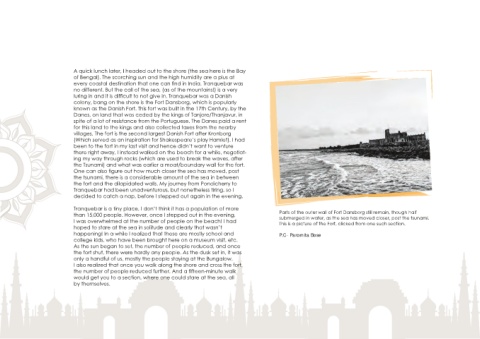
                           than 15,000 people. However, once I stepped out in the evening,         Parts of the outer wall of Fort Dansborg still remain, though half
                                                                                                   submerged in water, as the sea has moved closer, post the tsunami.
                           I was overwhelmed at the number of people on the beach! I had           This is a picture of the Fort, clicked from one such section.
                           hoped to stare at the sea in solitude and clearly that wasn’t
                           happening! In a while I realized that these are mostly school and       P.C- Paromita Bose
                           college kids, who have been brought here on a museum visit, etc.
                           As the sun began to set, the number of people reduced, and once
                           the fort shut, there were hardly any people. As the dusk set in, it was
                           only a handful of us, mostly the people staying at the Bungalow.
                           I also realized that once you walk along the shore and cross the fort,
                           the number of people reduced further. And a fifteen-minute walk
                           would get you to a section, where one could stare at the sea, all
                           by themselves.

