


Page 17 - TI Journal 18-1
P. 17
CSF SUPPRESSION METHODS FOR DTI                           11


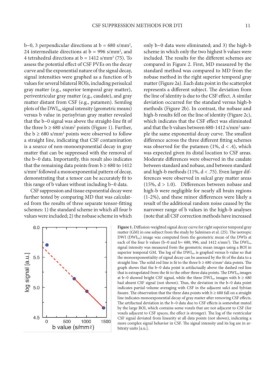
          b~0, 3 perpendicular directions at b = 680 s/mm ,   only b~0 data were eliminated; and 3) the high-b
                                                  2
          24 intermediate directions at b = 996 s/mm , and   scheme in which only the two highest b values were
                                              2
          4 tetrahedral directions at b = 1412 s/mm  (75). To   included. The results for the different schemes are
                                            2
          assess the potential effect of CSF PVEs on the decay   compared in Figure 2. First, MD measured by the
          curve and the exponential nature of the signal decay,   standard method was compared to MD from the
          signal intensities were graphed as a function of b   nobase method in the right superior temporal gray
          values for several bilateral ROIs, including perisulcal   matter (Figure 2a). Each data point in the scatterplot
          gray matter (e.g., superior temporal gray matter),   represents a different subject. The deviation from
          periventricular gray matter (e.g., caudate), and gray   the line of identity is due to the CSF effect. A similar
          matter distant from CSF (e.g., putamen). Semilog   deviation occurred for the standard versus high-b
          plots of the DWI iso signal intensity (geometric means)   methods (Figure 2b). In contrast, the nobase and
          versus b value in perisylvian gray matter revealed   high-b results fell on the line of identity (Figure 2c),
          that the b~0 signal was above the straight-line fit of   which indicates that the CSF effect was eliminated
          the three b ≥ 680 s/mm  points (Figure 1). Further,   and that the b values between 680-1412 s/mm  sam-
                                                                                            2
                             2
          the b ≥ 680 s/mm  points were observed to follow   ple the same exponential decay curve. The smallest
                         2
          a straight line, indicating that CSF contamination   difference across the three different fitting schemes
          is a source of non-monoexponential decay in gray   was observed for the putamen (1%, d < .4), which
          matter that can be suppressed with the removal of   was expected given its distal location to CSF areas.
          the b~0 data. Importantly, this result also indicates   Moderate differences were observed in the caudate
          that the remaining data points from b ≥ 680 to 1412   between standard and nobase, and between standard
          s/mm  followed a monoexponential pattern of decay,   and high-b methods (11%, d < .75). Even larger dif-
               2
          demonstrating that a tensor can be accurately fit to   ferences were observed in sulcal gray matter areas
          this range of b values without including b~0 data.   (15%, d > 1.0).   Differences between nobase and
            CSF suppression and tissue exponential decay were   high-b were negligible for nearly all brain regions
          further tested by comparing MD that was calculat-  (1-2%), and these minor differences were likely a
          ed from the results of three separate tensor-fitting   result of the additional random noise caused by the
          schemes: 1) the standard scheme in which all four b   narrower range of b values in the high-b analyses
          values were included; 2) the nobase scheme in which   (note that all CSF correction methods have increased

                                             Figure 1. Diffusion-weighted signal decay curve for right superior temporal gray
                                             matter (GM) in one subject from the study by Salminen et al. (25). The isotropic
                                             DWI (DWIiso) image was computed from the geometric mean of the DWIs at
                                                                                       2
                                             each of the four b values (b~0 and b= 680, 996, and 1412 s/mm ). The DWIiso
                                             signal intensity was measured from the geometric mean images using a ROI in
                                             superior temporal GM. The log of the DWIiso is graphed versus b value so that
                                             the monoexponentiality of signal decay can be assessed by the fit of the data to a
                                             straight line. The solid red line is fit to the three b ≥ 680 s/mm  data points. The
                                                                                     2
                                             graph shows that the b~0 data point is artifactually above the dashed red line
                                             that is extrapolated from the fit to the other three data points. The DWIiso images
                                             at b~0 showed bright CSF signal, while the three DWIiso images with b ≥ 680
                                             had absent CSF signal (not shown). Thus, the deviation in the b~0 data point
                                             indicates partial volume averaging with CSF in the adjacent sulci and Sylvian
                                             fissure. The observation that the three data points with b ≥ 680 fall on a straight
                                             line indicates monoexponential decay of gray matter after removing CSF effects.
                                             The artifactual deviation in the b~0 data due to CSF effects is somewhat muted
                                             by the large ROI, which contains some voxels that are not adjacent to CSF (for
                                             voxels adjacent to CSF spaces, the effect is stronger). The log of the ventricular
                                             CSF signal deviated from linearity at all data points (not shown), indicating a
                                             more complex signal behavior in CSF. The signal intensity and its log are in ar-
                                             bitraty units [a.u.].

