


Page 29 - TI Journal 18-1
P. 29
FIBER BUNDLE LENGTH IN CEREBRAL WHITE MATTER                      23


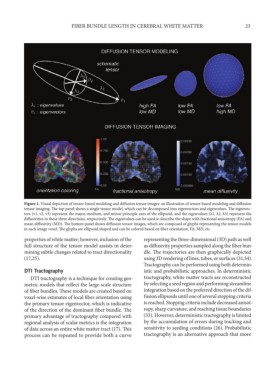
          Figure 1. Visual depiction of tensor-based modeling and diffusion tensor images: an illustration of tensor-based modeling and diffusion
          tensor imaging. The top panel shows a single tensor model, which can be decomposed into eigenvectors and eigenvalues. The eigenvec-
          tors (v1, v2, v3) represent the major, medium, and minor principle axes of the ellipsoid, and the eigenvalues (λ1, λ2, λ3) represent the
          diffusivities in these three directions, respectively. The eigenvalues can be used to describe the shape with fractional anisotropy (FA) and
          mean diffusivity (MD). The bottom panel shows diffusion tensor images, which are composed of glyphs representing the tensor models
          in each image voxel. The glyphs are ellipsoid shaped and can be colored based on fiber orientation, FA, MD, etc
          properties of white matter; however, inclusion of the   representing the three-dimensional (3D) path as well
          full structure of the tensor model assists in deter-  as diffusivity properties sampled along the fiber bun-
          mining subtle changes related to tract directionality   dle. The trajectories are then graphically depicted
          (17,25).                                      using 3D rendering of lines, tubes, or surfaces (31,54).
                                                       Tractography can be performed using both determin-
          DTI Tractography                              istic and probabilistic approaches. In deterministic
            DTI tractography is a technique for creating geo-  tractography, white matter tracts are reconstructed
          metric models that reflect the large-scale structure   by selecting a seed region and performing streamline
          of fiber bundles. These models are created based on   integration based on the preferred direction of the dif-
          voxel-wise estimates of local fiber orientation using   fusion ellipsoids until one of several stopping criteria
          the primary tensor eigenvector, which is indicative   is reached. Stopping criteria include decreased anisot-
          of the direction of the dominant fiber bundle. The   ropy, sharp curvature, and reaching tissue boundaries
          primary advantage of tractography compared with   (33). However, deterministic tractography is limited
          regional analysis of scalar metrics is the integration   by the accumulation of errors during tracking and
          of data across an entire white matter tract (17). This   sensitivity to seeding conditions (26). Probabilistic
          process can be repeated to provide both a curve   tractography is an alternative approach that more

