


Page 28 - TI Journal 18-1
P. 28
22                                   BAKER ET AL.


      curvature of white matter pathways using in vivo   DTI Scalar Metrics
      imaging (17). This method is highly sensitive to white     A symmetric 3x3 diffusion tensor characterizes
      matter changes within entire tracts and, therefore,   water diffusion in brain tissues. This model represents
      may be more advantageous than methods that involve   the diffusion pattern with a second-order tensor that
      placing regions of interest on two-dimensional scalar   can be decomposed into three non-negative eigen-
      DTI parameter maps (17). In this review, we describe   values and three eigenvectors that describe the mag-
      the fundamentals of the diffusion tensor model and   nitude and orientation of water diffusion in each
      qtDTI technology. We then review the existing liter-  voxel (Figure 1). Eigenvalues describe the shape and
      ature on length-based metrics using qtDTI, followed   size of the tensor, independent of orientation, while
       by a discussion of the strengths and limitations of   eigenvectors describe the orientation of the tensor,
      qtDTI. Finally, a brief review of future applications   independent of shape and size. The tensor model
      is provided.                                  parameterizes the diffusion in each voxel with an
                                                    ellipsoid whose diameter in any direction estimates
      DIFFUSION MR TECHNIQUES                       the diffusivity in that direction and whose major prin-
      DTI Physical Basis                            ciple axis is oriented in the direction of maximum
        DTI is a noninvasive magnetic resonance imag-  diffusivity. The major axis of the ellipsoid (v1) points
      ing (MRI) technology that measures water diffusion   in the direction of the maximum diffusivity (λ1) of
      at each voxel in the brain. Water molecules diffuse   a voxel. The direction of the maximum diffusion is
      differently along tissues depending on tissue micro-  oriented in the direction of the major fiber tract in
       structure and the presence of anatomical barriers.   the voxel. The directions perpendicular to the main
      One simple and useful way to characterize diffusion   fiber orientation along the medium (v 2) and minor
      at a location in the brain is along a spectrum between    axes (v3) of the diffusion ellipsoid are also computed
      isotropic and anisotropic. Diffusion that is highly   (λ2, λ3) in the tensor analysis. DTI scalar metrics are
       similar in all directions (i.e., isotropic diffusion) is   functions of three diffusion eigenvalues (λ1, λ2, λ3).
      typically observed in grey matter and cerebrospinal   Axial diffusivity (AD = λ1) is the maximum diffu-
      fluid. By contrast, directionally dependent diffusion   sivity in the voxel and decreases with greater axonal
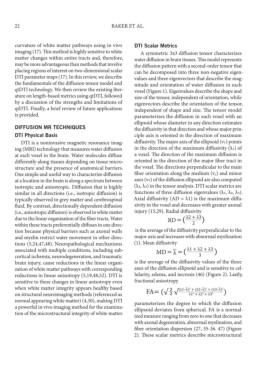
      (i.e., anisotropic diffusion) is observed in white matter   injury (15,29). Radial diffusivity
      due to the linear organization of the fiber tracts. Water
      within these tracts preferentially diffuses in one direc-
      tion because physical barriers such as axonal walls    is the average of the diffusivity perpendicular to the
      and myelin restrict water movement in other direc-  major axis and increases with abnormal myelination
      tions (5,24,47,48). Neuropathological mechanisms   (1). Mean diffusivity
      associated with multiple conditions, including sub-
      cortical ischemia, neurodegeneration, and traumatic
       brain injury, cause reductions in the linear organi-  is the average of the diffusivity values of the three
      zation of white matter pathways with corresponding   axes of the diffusion ellipsoid and is sensitive to cel-
      reductions in linear anisotropy (5,19,48,52). DTI is   lularity, edema, and necrosis (46) (Figure 2). Lastly,
       sensitive to these changes in linear anisotropy even   fractional anisotropy
      when white matter integrity appears healthy based
      on structural neuroimaging methods (referenced as
      normal appearing white matter) (4,30), making DTI   parameterizes the degree to which the diffusion
      a powerful in vivo imaging method for the examina-  ellipsoid deviates from spherical. FA is a normal-
      tion of the microstructural integrity of white matter.   ized measure ranging from zero to one that decreases

                                                    with axonal degeneration, abnormal myelination, and
                                                    fiber orientation dispersion (27, 35-36. 47) (Figure
                                                    2). These scalar metrics describe microstructural

