


Page 30 - TI Journal 18-1
P. 30
24                                   BAKER ET AL.


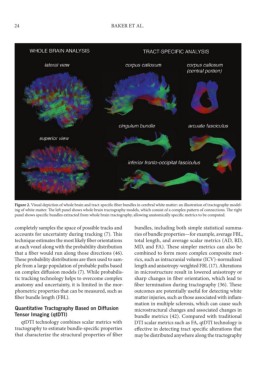
      Figure 2. Visual depiction of whole brain and tract-specific fiber bundles in cerebral white matter: an illustration of tractography model-
      ing of white matter. The left panel shows whole brain tractography models, which consist of a complex pattern of connections. The right
      panel shows specific bundles extracted from whole brain tractography, allowing anatomically specific metrics to be computed.

      completely samples the space of possible tracks and   bundles, including both simple statistical summa-
      accounts for uncertainty during tracking (7). This   ries of bundle properties—for example, average FBL,
      technique estimates the most likely fiber orientations   total length, and average scalar metrics (AD, RD,
      at each voxel along with the probability distribution   MD, and FA). These simpler metrics can also be
      that a fiber would run along those directions (46).   combined to form more complex composite met-
      These probability distributions are then used to sam-  rics, such as intracranial volume (ICV)-normalized
      ple from a large population of probable paths based   length and anisotropy-weighted FBL (17). Alterations
      on complex diffusion models (7). While probabilis-  in microstructure result in lowered anisotropy or
      tic tracking technology helps to overcome complex   sharp changes in fiber orientation, which lead to
      anatomy and uncertainty, it is limited in the mor-  fiber termination during tractography (36). These
      phometric properties that can be measured, such as   outcomes are potentially useful for detecting white
      fiber bundle length (FBL).                    matter injuries, such as those associated with inflam-
                                                    mation in multiple sclerosis, which can cause such
      Quantitative Tractography Based on Diffusion   microstructural changes and associated changes in
      Tensor Imaging (qtDTI)                        bundle metrics (42). Compared with traditional
        qtDTI technology combines scalar metrics with   DTI scalar metrics such as FA, qtDTI technology is
      tractography to estimate bundle-specific properties   effective in detecting tract specific alterations that
      that characterize the structural properties of fiber   may be distributed anywhere along the tractography

