


Page 86 - TI Journal 18-1
P. 86
80                                 THE NAI PROFILE


      the U.S. National Academies of Science, Engineering,   you feel about having traversed such a wide intel-
      and Medicine and elected a fellow of the National   lectual terrain. In terms of invention and innovation,
      Academy of Inventors, the American Association   what advantages do your multiple perspectives offer.
      for the Advancement of Science, and the American   Arnold: I have no doubt that my unusual training,
      Academy of Arts and Sciences.                 and even my lack of formal training in biochemis-
        Arnold has been lauded for her pioneering work in   try, contributed to the invention of directed enzyme
      directed evolution, which allows for the engineering   evolution. I came at the protein engineering problem
      of proteins through the recombination or mutation of   from an engineering perspective, free from the rigor
      genes, followed by a careful artificial selection process   that biochemical scientists feel the need to use. Rather
      to choose the desired traits. The resulting engineered   than try to minimize the complexity of proteins by
      proteins have the potential to revolutionize how we   developing a ‘rational’ design approach, which would
       solve major global issues in health care, agriculture,   require that I understand the system in detail, I used
      and sustainable energy, among many other areas. For   what has worked well for billions of years: evolution.
      example, her work with the P450 enzyme has opened   I use technology to speed it up a bit.
      new, sustainable routes to pharmaceutical interme-
      diates, safer ways to protect crops, and enhanced   T&I: When you first published work on protein
      neuroimaging. The Arnold research group is a breed-  engineering, the divide between pure and applied
      ing ground for some of the most innovative work in   science was pronounced. From your perspective as
       bioengineering being done today, and, a gifted teacher   a renowned scientist and a holder of 49 patents, to
      as well as researcher, Arnold is also fostering a new   what extent has the relationship between pure and
      generation of innovators in her laboratory.   applied science changed?
        T&I was honored when Dr. Arnold agreed to dis-  Arnold: I will answer this big and interesting question
      cuss her most recent work and to share her thoughts   only from the perspective of protein engineering and
      on the benefits of her eclectic background to her   directed evolution. I always try to do both pure and
       success, the divide between pure and applied science,   applied science, solving an important problem while
      and strategies for teaching students to innovate.  learning something deeper and more general along

      INTERVIEW
      T&I: How would you describe your current work
      in a nutshell?
      Arnold: I am interested in the evolution of chemical
      novelty—specifically, how do new enzyme catalysts
      arise from old ones. It happened a gazillion times in
      nature, but it’s hard to capture evolution in the act.
      We can only see the results, usually well after the new
      and old functions diverged. I ‘breed’ enzymes in the
       laboratory, using mutation and recombination (a kind
      of ‘molecular sex’), to better understand how new cat-
      alytic activities appear and also to create catalysts that
      nature never made but are useful to humans. These
      experiments demonstrate the power of evolution as
      an innovation machine.
      T&I: Your original training was in mechanical and
      aerospace engineering, your Ph.D. was in chemical
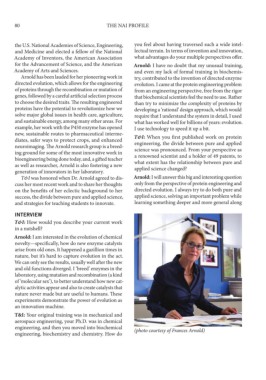
      engineering, and then you moved into biochemical   (photo courtesy of Frances Arnold)
      engineering, biochemistry and chemistry. How do

