


Page 155 - T-I JOURNAL19 4
P. 155
802   HALL, DYER & MACUARE                 NAI CHAPTER SPOTLIGHT                            803


 Figure 2. Speakers at the launch of the USC Chapter of the National Academy of Inventors were (left to
 right): Jennifer Dyer (Executive Director, USC Stevens Center for Innovation), Randolph Hall (USC’s
 Vice President of Research), Robert V. Duncan (Board Member of the National Academy of Inventors
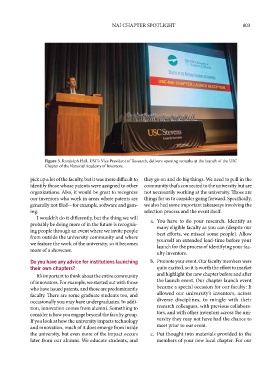
 and Vice President for Strategic Research Initiatives at Texas Tech University), and Michael Arciero   Figure 3. Randolph Hall, USC’s Vice President of Research, delivers opening remarks at the launch of the USC
 (Director of Technology Licensing & New Ventures, USC Stevens Center for Innovation).  Chapter of the National Academy of Inventors.

 many other functions. We wanted to draw attention  talk to our colleagues. We want to do research that   pick up a lot of the faculty, but it was more difficult to  they go on and do big things. We need to pull in the
 to our place in downtown, which itself has under-  benefits society. That’s what we mean by consequence.   identify those whose patents were assigned to other  community that’s connected to the university but are
 gone a huge change in the last five years because of  We want to create within this university an environ-  organizations. Also, it would be great to recognize  not necessarily working at the university. Those are
 an enormous amount of development occurring in  ment where our faculty, students, and staff can thrive   our inventors who work in areas where patents are  things for us to consider going forward. Specifically,
 the neighborhood around our USC building.   through the impact they’re creating, benefitting real   generally not filed—for example, software and gam-  we also had some important takeaways involving the
   When we gave out awards, people were tremen-  people and not just the scholarly community. That’s   ing.   selection process and the event itself:
 dously honored. Some received multiple recognitions.  the kind of thing we want to recognize in this pro-    I wouldn’t do it differently, but the thing we will
 We awarded certificates to all USC NAI chapter  gram. So far, we have focused on the initial group of   probably be doing more of in the future is recogniz-  a.  You have to do your research. Identify as
 inductees. In addition, people whose technology had  patent holders—the group of inductees— mirroring   ing people through an event where we invite people     many eligible faculty as you can (despite our
 been licensed received a Lucite award. The event  the criteria that NAI itself has established for the   from outside the university community and where     best efforts, we missed some people). Allow
 showed that USC cares about people who are coming  fellows, but we want to broaden that to recognize   we feature the work of the university, so it becomes     yourself an extended lead-time before your
 up with ideas that benefit society, ideas that were  everywhere impact is occurring. Of course, the reality   more of a showcase.     launch for the process of identifying your fac-
 reflected in the patents that we’ve obtained and the  of the patent itself is maybe a step towards impact,     ulty inventors.
 licenses that we’ve signed, which means somebody  but it doesn’t guarantee impact either. We want to   Do you have any advice for institutions launching   b.  Promote your event. Our faculty members were
 wants to take the technology forward. Traditionally,  honor innovations that are being adopted and used   their own chapters?    quite excited, so it is worth the effort to market
 when somebody gets a patent issued, they’ll be noti-  broadly around the world.    It’s important to think about the entire community     and highlight the new chapter before and after
 fied, but this is more. This is a way to show that we   of innovators. For example, we started out with those     the launch event. Our chapter launch event
 care.   In starting the chapter and holding your first   who have issued patents, and those are predominantly     became a special occasion for our faculty: It
 induction event, did you learn anything through            allowed our university’s inventors, across
 Why do you think it’s so important to recognize  that process? Are you thinking of doing anything   faculty. There are some graduate students too, and     diverse disciplines, to mingle with their
             occasionally you may have undergraduates. In addi-
 academic innovation?  differently next time?  tion, innovation comes from alumni. Something to     research colleagues, with previous collabora-
   In our strategic plan, we emphasize “scholarship    In launching our USC NAI chapter, we wanted   consider is how you engage beyond the faculty group.     tors, and with other inventors across the uni-
 with consequence.” We do research and conduct  to include all the USC faculty that had issued U.S.   If you look at how the university impacts technology     versity they may not have had the chance to
 scholarship within the university, and that research  patents in our inaugural class, but we found the task of   and innovation, much of it does emerge from inside     meet prior to our event.
 results in publications. Most publications get cited,  identifying these faculty members to be challenging.   the university, but even more of the impact occurs   c.  Put thought into materials provided to the
 but, in the end, we don’t do research solely so we can  We were able to search patents assigned to USC and   later from our alumni. We educate students, and     members of your new local chapter. For our

