


Page 157 - T-I JOURNAL19 4
P. 157
INNOVATION


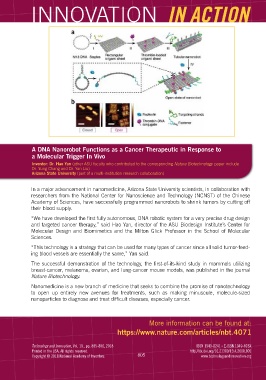
             A DNA Nanorobot Functions as a Cancer Therapeutic in Response to
             a Molecular Trigger In Vivo
             Inventor: Dr. Hao Yan (other ASU faculty who contributed to the corresponding Nature Biotechnology paper include
             Dr. Yung Chang and Dr. Yan Liu)
             Arizona State University (part of a multi-institution research collaboration)


             In a major advancement in nanomedicine, Arizona State University scientists, in collaboration with
             researchers from the National Center for Nanoscience and Technology (NCNST) of the Chinese
             Academy of Sciences, have successfully programmed nanorobots to shrink tumors by cutting off
             their blood supply.

             “We have developed the first fully autonomous, DNA robotic system for a very precise drug design
             and targeted cancer therapy,” said Hao Yan, director of the ASU Biodesign Institute’s Center for
             Molecular Design and Biomimetics and the Milton Glick Professor in the School of Molecular
             Sciences.

             “This technology is a strategy that can be used for many types of cancer since all solid tumor-feed-
             ing blood vessels are essentially the same,” Yan said.

             The successful demonstration of the technology, the first-of-its-kind study in mammals utilizing
             breast-cancer, melanoma, ovarian, and lung-cancer mouse models, was published in the journal
             Nature Biotechnology.
             Nanomedicine is a new branch of medicine that seeks to combine the promise of nanotechnology
             to  open up  entirely new  avenues for  treatments, such as making minuscule, molecule-sized
             nanoparticles to diagnose and treat difficult diseases, especially cancer.


                                                          More information can be found at:
                                             https://www.nature.com/articles/nbt.4071

             Technology and Innovation, Vol. 19., pp. 805-806, 2018         ISSN 1949-8241  •    E-ISSN 1949-825X
             Printed in the USA. All rights reserved.                    http://dx.doi.org/10.21300/19.4.2018.805
             Copyright © 2018 National Academy of Inventors.  805            www.technologyandinnovation.org

