


Page 31 - T-I JOURNAL19 4
P. 31
GENDER DATA GAP                                679


             not considered gender tracking to be an import-    capability of their software to track gender
             ant demographic to collect from those who submit   •  A feeling that they could access the data
             invention disclosures, while 11% reported that they     through another  campus resource  if  they
             did not know why their offices did not track gender     needed or wanted
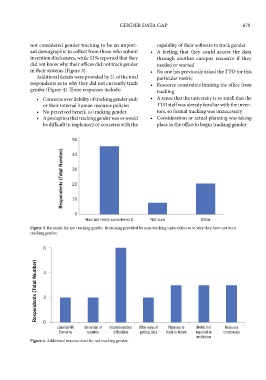
             in their systems (Figure 3).                 •  No one has previously asked the TTO for this
               Additional details were provided by 21 of the total     particular metric
             respondents as to why they did not currently track   •  Resource constraints limiting the office from
             gender (Figure 4). These responses include:    tracking

               •  Concerns over liability of tracking gender and/   •  A sense that the university is so small that the
                 or their internal human resource policies    TTO staff was already familiar with the inven-
               •  No perceived benefit to tracking gender    tors, so formal tracking was unnecessary
               •  A perception that tracking gender was or would    •  Consideration or actual planning was taking
                 be difficult to implement or concerns with the      place in the office to begin tracking gender


                         50  50

                     Respondents (Total Number)  Respondents (Total Number)  30  30
                            40
                         40


                            20
                         20
                            10
                         10
                             0
                                 Had not really considered it  Not sure      Other
                          0
             Figure 3. Rationale for not tracking gender. Reasoning provided by non-tracking universities as to why they have not been
                                                         Not sure
                               Had not really considered it
                                                                              Other
             tracking gender.
                     6
                 6   4

               Respondents (Total Number)  4 Respondents (Total Number)  2


                 2
                     0
                                            Implementation
                                                                          Metric not
                                                                                    Resource
                                                      Other ways of
                                                                 Planning to
                                    Uncertain of
                          Liability/HR
                                                       getting data
                           Concerns
                                     benefits
                                              difficulties
                                                                          institution
                 0
                                                                            Metric not
                                                                                      Resource
                       Liability/HR  Uncertain of  Implementation  Other ways of  track in future  required by  constraints
                                                                 Planning to
                       Concerns   benefits   difficulties  getting data  track in future  required by  constraints
                                                                           institution
             Figure 4. Additional reasons cited for not tracking gender.

