


Page 96 - T-I JOURNAL19 4
P. 96
744                                  COUCH ET AL.                                                                                      ADDRESSING THE GENDER GAP                            745


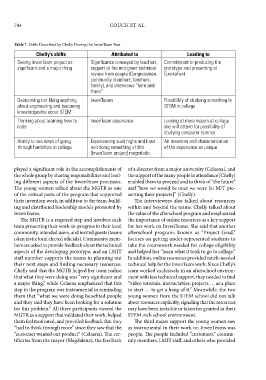
      Table 7. Shifts Described by Chelly During the InvenTeam Year                                              support and feedback at the MGTR and along the  teammates had limited time to fully engage in and
               Chelly’s shifts             Attributed to                Leading to                               way. However, the most significant people supporting  understand all of the processes necessary for invent-
                                                                                                                 their journeys were parents and teachers. Magdalena  ing. As mentioned above, it was not until the MGTR
        Seeing InvenTeam project as   Significance conveyed by teachers,  Commitment to producing the            talked about her teachers, who provided guidance  in February that Chelly realized the importance of
        significant and a major thing  support at the mid-grant technical  prototype and presenting at           and shared their technical expertise, while Celaena  her team’s project—not just for the team but also for
                                   review from people (Congressman,  EurekaFest
                                   community members, teachers,                                                  and Chelly talked about their parents more. Celaena  the larger community interested in seeing the proto-
                                   family), and interviews “here and                                             stated that her parents “forced me to go to STEM” but  type. Time was an issue for Celaena and Magdalena,
                                   there”                                                                        then provided the support needed for her to succeed  who worked on their InvenTeam project during the
                                                                                                                 in school and the InvenTeam project. Chelly, on the  school day, afterschool, and on Saturdays because
        Overcoming not liking anything  InvenTeams             Possibility of studying something in
        about engineering and becoming                         STEM in college                                   other hand, emphasized her mother’s role in pushing  they had multiple demands. Celaena stated that her
        knowledgeable about STEM                                                                                 “that idea [to go to college] on me” and getting her  “tenth grade was the hardest year. I had to prioritize
                                                                                                                 to join Project Grad and the afterschool InvenTeam.  InvenTeams over robotics …[and] got really over-
        Thinking about learning how to  InvenTeam experience   Looking at more majors at college                   The InvenTeam organization and processes, the  whelmed.” Magdalena also talked about “scheduling
        code                                                   she will attend for possibility of                resources, and the people were significant supports  difficulties” and a conflict with robotics, noting that
                                                               studying computer science
                                                                                                                 in the young women’s engagement with invention,  the inventing “wasn’t going as quick as it needed to
        Ability to see ways of going  Experiencing such highs and lows  An invention and characterization        but, ultimately, they saw their own personal qualities,  be,” and she “was scared” because they “were going to
        through hardships in college  and doing something of this  of the experience as unique                   values, and beliefs as forces driving their success in  lose a lot of [team members with coding experience]
                                   [InvenTeam project] magnitude                                                 InvenTeams and STEM. Celaena took pride in her  for a while” due to schedule conflicts with robotics.
                                                                                                                 “ability to speak to people” and to create “harmony”  Thus, as the participants made visible in the inter-
      played a significant role in the accomplishments of  of a director from a major university (Celaena), and   when “dealing with a bunch of people.” Magdalena  views, inventing requires significant amounts of time,
      the whole group by sharing responsibilities and lead-  the support of the many people in attendance (Chelly)   emphasized the importance of her leadership skills  which becomes a challenge for high school students
      ing different aspects of the InvenTeam processes.  enabled them to proceed and to think of “the future”    and her ability to “take charge … so that things are  who have multiple demands on their time. Magdalena
      The young women talked about the MGTR as one  and “how we would be once we were [at MIT pre-               happening.” Meanwhile, Chelly talked about her  estimated that she spent seven to eight hours per
      of the critical parts of the program that supported  senting their projects]” (Chelly).                    “many interests” and associated her ability to look   week working on the invention, while Celaena and
      their invention work, in addition to the team-build-    The interviewees also talked about resources       at “engineering [as] a growing industry I should   Chelly both thought that they spent nine to 10 hours
      ing and distributed leadership models promoted by  within and beyond the teams. Chelly talked about        learn about” with her “love to learn” attitude and her   per week.
      InvenTeams.                                 the value of the afterschool program and emphasized            recollection of “always loving school.” She also said     Participants not only felt constrained by time
        The MGTR is a required step and involves each  the importance of online resources as a key support       her wanting to “do something good … that will impact   but also by the stereotypes about women in STEM.
      team presenting their work-in-progress to their local  for her work on InvenTeams. She said that another   community” sustained her through the “highs and   Celaena was most explicit about the stereotypes, stat-
      community, intended users, and invited guests (teams  afterschool  program,  known  as  “Project  Grad,”   lows” of the experience, leading to more confidence   ing that there is a “stereotype on girls that you are not
      often invite local elected officials). Community mem-  focuses on getting under-represented students to    in her ability to persist and to “make it” in college.   supposed to be interested.” Talking about her shift
      bers are asked to provide feedback about the technical  take the coursework needed for college eligibility   Constraints                              to math becoming her strongest subject, she said
      aspects of the developing prototype, and an LMIT  and helped her “learn what it took to go to college.”                                               that previously she heard “you’re not supposed to be
      staff member supports the teams in planning out  In addition, online resources provided much-needed          The young women interviewed for this research  interested,” and she believed that STEM “was sitting
      their next steps and finding necessary resources.  technical help for the InvenTeam work. Since Chelly’s   emphasized their successes and supports, but they  in a classroom doing math equations all day.” If not
      Chelly said that the MGTR helped her team realize  team worked exclusively in an afterschool environ-      also shared the constraints and challenges they expe-  for her parents’ support and push to go to a STEM
      that what they were doing was “very significant and  ment with less technical support, they needed to find   rienced. Our analyses of the interviews identified  school, she may never have come to see herself as
      a major thing,” while Celaena emphasized that this  “video tutorials, instructables, projects … as a place   three factors constraining the work of InvenTeams:  an inventor. Chelly did not state the stereotypes as a
      step in the program was instrumental in reminding  to start … to get a hang of it.” Meanwhile, the two     1) time; 2) stereotypes; and 3) lack of knowledge,  constraint explicitly, but, in describing her experience,
      them that “what we were doing benefited people  young women from the STEM school did not talk              exposure, understanding, and engagement.   she indicated that prior to the afterschool leader’s
      and they said they have been looking for a solution  about resources explicitly, signaling that the resources     InvenTeam students have one school year to com-  invitation, she had not considered coding or STEM
      for this problem.” All three participants viewed the  may have been invisible or taken for granted in their   plete phases 4 through 8 of the InvenTeam grant cycle  as a pathway for her future. The participants had to
      MGTR as a support that validated their work, helped  STEM-rich school environment.                         outlined in Table 1. Periodic check-ins and one site  overcome stereotypes about females in STEM in order
      them feel motivated, and provided feedback that they    The third major support the young women saw        visit by LMIT staff help the teams maintain momen-  to see themselves as leaders, innovators, inventors,
      “had to think through more” since they saw that the  as instrumental in their work on InvenTeams was       tum and use their time effectively, but, as the young  and important members of InvenTeams.
      “customer wanted our product” (Celaena). The cer-  people. The people included “customers,” commu-         women shared, time was a challenge. InvenTeam work    While time and stereotypes were significant con-
      tificates from the mayor (Magdalena), the feedback  nity members, LMIT staff, and others who provided      was an afterschool activity for Chelly, so she and her  straints, the constraints that the participants described

