


Page 93 - T-I JOURNAL19 4
P. 93
ADDRESSING THE GENDER GAP                           741


             including leader, creator, maker, and innovator.  innovation, and her overall shift toward self-identi-
             Chelly self-identified as an innovator.    fication as an inventor.
               Because Celaena and Magdalena were on an      Celaena shared in the interview that her work on
             InvenTeam from a STEM magnet school with over  the InvenTeam helped her develop the ability to have
             half of the work being done outside of the school  in-depth intellectual conversations with adults. She
             day, and Chelly was in an afterschool program, we  attributed this new ability to her work with adults
             wondered how their work on their teams and their  and people she characterized as being “high up on
             school environments may have influenced their  the food chain.” The people she saw as important
             self-identifications. Therefore, we first examined how  included community members, Lemelson-MIT staff,
             the three participants described shifts in the way they  mentor teachers, and other adults who supported
             saw themselves and possibilities for their future as  the students throughout their InvenTeam experi-
             inventors. Subsequently, we examined the contexts  ence. Celaena stated that these “in-depth intellectual
             that they described as supporting or constraining  conversations with adults” led to “driving up [her]
             their engagement in STEM and invention education.  confidence” as a learner, a leader, and an inventor.
                                                          Celaena’s second shift revolved around overcom-
             Shifts Experienced by Three Young Women on  ing her dislike of math and science and starting to
             InvenTeams Made Visible in Interviews      see math as her “strongest subject.” She credits this
               Following the survey responses on the self-identifi-  to her introduction to the type of STEM she likes,
             cation question, we began our analyses by examining  which has led to both “liking STEM” and taking
             how the three participants described the shifts they  accelerated mathematics courses that allowed her to
             experienced while working on their InvenTeams.  complete two years of math requirements in one year.
             “Shifts” refers to changes in ways of thinking, know-  She now considers math her strongest subject, and
             ing, or being that each young woman articulated in  she even had to take math at the nearby community
             the interview. Table 5 demonstrates that, for Celaena,  college because she ran out of math classes at her
             the key changes included a shift in her ability to have  high school.
             intellectual conversations with adults, a shift from    Like the shift around math, the shift to loving
             disliking math to seeing it as her “strongest subject,”  engineering and the creative process was linked to
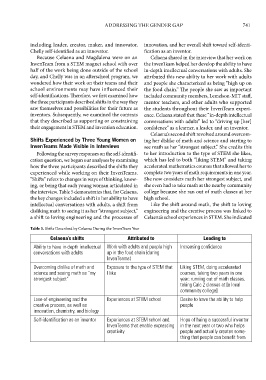
             a shift to loving engineering and the processes of  Celaena’s school experiences in STEM. She indicated
             Table 5. Shifts Described by Celaena During the InvenTeam Year

                    Celaena’s shifts             Attributed to                Leading to
              Ability to have in-depth intellectual  Work with adults and people high  Increasing confidence
              conversations with adults   up in the food chain (during
                                          InvenTeams)
              Overcoming dislike of math and  Exposure to the type of STEM that  Liking STEM, doing accelerated
              science and seeing math as “my  I like                 courses, taking two years in one
              strongest subject”                                     year; running out of math classes,
                                                                     taking Calc 2 classes at [a local
                                                                     community college]
              Love of engineering and the  Experiences at STEM school  Desire to have the ability to help
              creative process, as well as                           people
              innovation, chemistry, and biology
              Self-identification as an inventor  Experiences at STEM school and  Hope of being a successful inventor
                                          InvenTeams that enable expressing  in the next year or two who helps
                                          creativity                 people and actually creates some-
                                                                     thing that people can benefit from

