


Page 91 - T-I JOURNAL19 4
P. 91
ADDRESSING THE GENDER GAP                           739


             to interviewing “allowed for gathering rich, detailed  students strongly agreeing with each of the statements
             data directly” from InvenTeam students to help us  was significantly higher than male students. Our
             generate insights and empirical evidence for making  attempts to find a reason for the difference led us to
             warranted claims in relation to the research questions  a deeper investigation of another survey question
             (17). Students were invited to select their own pseud-  in which students were given a set of descriptors
             onyms. Interviews were recorded, transcribed in a  that could potentially be used to describe themselves
             pragmatic way to match the content-focused research  and were asked to mark all terms with which they
             purpose (18), and analyzed using ethnographic  identified. There was no significant gender-based
             research methods, including semantic analysis (19).  difference in the students who identified as inventors,
             The tracing of the three young women’s perspectives  as 21 females (34.4%) identified as inventors, com-
             and experiences afforded opportunities to uncover  pared to 26 males (32.9%). However, a gender-based
             changes in their ways of thinking attributed to their  comparison of InvenTeam participants’ selections of
             InvenTeam experience and factors that supported  other types of descriptions of self revealed a differ-
             and constrained their work.                ence between female and male participants. Table 3
                                                        shows that “leader” and “innovator” were the two
             ANALYSES                                   top choices for females, garnering response rates
                                                        that exceeded 50%. “Engineer” was the only term
             Gender-Based Differences in Survey Responses  garnering a response rate of 50% or greater by males.
               We utilized the most recent (2017) end-of-year  Like their female counterparts, a high percentage of
             survey to examine the first research question focusing  males identified as leaders.
             on how InvenTeam members represent their expe-    The survey responses indicating greater agreement
             riences and whether there were differences in the  in the “strongly agree” category for “learning from
             self-reported experiences of young women and young  failure,” “developing self-confidence,” “persistence,”
             men. The 2017 survey, in which 73% of the students  and inscriptions of self as innovators and leaders by
             responded, showed 81% of total respondents (n =  more than 50% of the females—versus the males’
             126) agreed or strongly agreed that “working on our  choice of engineer—hinted at gender-oriented dif-
             InvenTeam project taught me to learn from failure,”  ferences among the experiences students brought to,
             84% of respondents (n = 124) agreed or strongly  developed, and then took away from their InvenTeams
             agreed that “I developed self-confidence in my abil-  work. However, survey data alone was not sufficient to
             ity to solve problems,” and 84% of respondents (n  help us understand why differences existed between
             = 126) agreed or strongly agreed that “working on  female and male students. The differences led us to
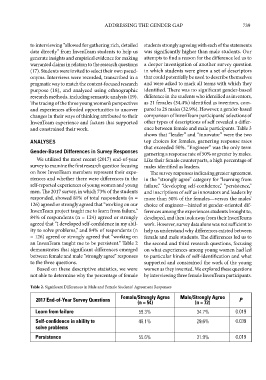
             an InvenTeam taught me to be persistent.” Table 2  the second and third research questions, focusing
             demonstrates that significant differences emerged  on what experiences among young women had led
             between female and male “strongly agree” responses  to particular kinds of self-identification and what
             to the three questions.                    supported and constrained the work of the young
               Based on these descriptive statistics, we were   women as they invented. We explored these questions
             not able to determine why the percentage of female  by interviewing three female InvenTeam participants.

             Table 2. Significant Differences in Male and Female Students’ Agreement Responses

               2017 End-of-Year Survey Questions  Female/Strongly Agree  Male/Strongly Agree  P
                                                     (n = 54)
                                                                           (n = 72)
              Learn from failure                      59.3%                 34.7%         0.019
              Self-condence in ability to            49.1%                 29.6%         0.039
              solve problems
              Persistence                             55.6%                 31.9%         0.019

