


Page 36 - T-I JOURNAL19-3
P. 36
596                                      FARID


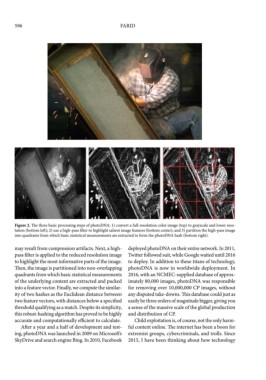
      Figure 2. The three basic processing steps of photoDNA: 1) convert a full-resolution color image (top) to grayscale and lower reso-
      lution (bottom left); 2) use a high-pass filter to highlight salient image features (bottom center); and 3) partition the high-pass image
      into quadrants from which basic statistical measurements are extracted to form the photoDNA hash (bottom right).

      may result from compression artifacts. Next, a high-  deployed photoDNA on their entire network. In 2011,
      pass filter is applied to the reduced resolution image  Twitter followed suit, while Google waited until 2016
      to highlight the most informative parts of the image.  to deploy. In addition to these titans of technology,
      Then, the image is partitioned into non-overlapping  photoDNA is now in worldwide deployment. In
      quadrants from which basic statistical measurements  2016, with an NCMEC-supplied database of approx-
      of the underlying content are extracted and packed  imately 80,000 images, photoDNA was responsible
      into a feature vector. Finally, we compute the similar-  for removing over 10,000,000 CP images, without
      ity of two hashes as the Euclidean distance between  any disputed take-downs. This database could just as
      two feature vectors, with distances below a specified  easily be three orders of magnitude bigger, giving you
      threshold qualifying as a match. Despite its simplicity,  a sense of the massive scale of the global production
      this robust-hashing algorithm has proved to be highly  and distribution of CP.
      accurate and computationally efficient to calculate.    Child exploitation is, of course, not the only harm-
        After a year and a half of development and test-  ful content online. The internet has been a boon for
      ing, photoDNA was launched in 2009 on Microsoft’s  extremist groups, cybercriminals, and trolls. Since
      SkyDrive and search engine Bing. In 2010, Facebook  2015, I have been thinking about how technology

