


Page 105 - Technology and Innovation Journal - 19-1
P. 105
THE NAI PROFILE                              443


             amazing elastomers for athletic footwear all the way
             to high-temperature materials used in demanding
             applications in aerospace and medical that are rigid
             and sterilizable. Some even have flame retardancy
             for use in some really demanding application spaces.
               So, at Carbon, it’s hardware, it’s software, it’s res-
             ins. The M1 itself is internet-connected and streams
             a lot of data back to us on an ongoing basis, which
             helps us constantly to improve how our technology
             works for our customers and partners. This ushers
             in a whole new frontier of how people make things
             with equipment that gets better with time. We push
             features to the printer itself, doing software upgrades
             every six or seven weeks, and, with those software
             upgrades, machine performance continues to get
             better. We can add new resins easily and give people
             the power to use new resins and new features.
               We’re really a data-centric company, and this also
             shifts the whole concept of provenance associated
             with parts. The idea that when people make a part
             using our technology, we know all the born-on data,
             all the conditions of the printer when a given part was
             made—how it was printed, which lot, which resins,
             which specific machine, which processing equipment
             was used to bake it—this allows us to raise the bar on
             authenticity of parts and part quality. We think people
             and businesses around the world are really going to
             love having data to track parts that are serialized, all
             the way back to a part’s origin. From a product safety
             and liability point of view, it’s a pretty amazing shift
             that ushers in new business models. Just look at recent
             cases of companies not knowing which cars contain
             terrible, defective air impact bags. We’re talking about
             hundreds of thousands, even millions, of cars. What
             a mess that is! The idea that we can change this kind
             of scenario through digital and additive by having a
             unique identifier on every part—we’re going to open
             up new business models.
             T&I: So, really, this technology is going to be a
             breeding ground for complementary technologies—
             hardware, software, materials etc.

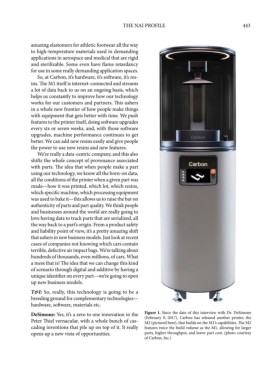
             DeSimone: Yes, it’s a zero to one innovation in the   Figure 1. Since the date of this interview with Dr. DeSimone
             Peter Thiel vernacular, with a whole bunch of cas-  (February 9, 2017), Carbon has released another printer, the
                                                        M2 (pictured here), that builds on the M1’s capabilities. The M2
             cading inventions that pile up on top of it. It really   features twice the build volume as the M1, allowing for larger
             opens up a new vista of opportunities.     parts, higher throughput, and lower part cost. (photo courtesy
                                                        of Carbon, Inc.)

