


Page 131 - MARSIUM'21 COMP OF PAPER
P. 131
CHAI JING MIN (2022)
            Brand Loyalty
            Consumers' positive associations with a brand or product are referred to as brand loyalty. Customers that demonstrate brand loyalty are always
            loyal to services or products, as evidenced by their repurchasing, despite the attempts of rivals to persuade them to switch. The corporation has
            made  significant investments in client  service  as well as  marketing in order to build and retain brand loyalty among customers for established
            items. Brand loyalty is the commitment to  consistently repurchase a preferred service or product in  future,  irrespective  of the marketing
            strategies or situational variables that may affect switching behaviour. (Oliver, 1997; 1997)

            The foundation of brand value is the brand loyalty. It is divided into five categories: unbranded loyalist, habitual buyers, satisfactory buyers,
            emotional purchasers, as well as loyal buyers. Unbranded loyalists, in this stratum of customers, will continually switch brands, do not concur
            with a brand, and are normally price sensitive. Select the  cheapest option. Several low-value consumables, homogenous sectors, and everyday
            consumer items lack loyal brands. Customers who are habitual purchasers are loyal towards specific brands, have fixed consuming patterns
            and preferences, understand what they want when they purchase, and have specific  goals. Customers are tempted to check it out  if rivals  offer clear
            incentives including price discounts, advertising, distinctive packaging, direct marketing, and so on. If this is permitted to purchase or repeat
            a product, this can be branded towards purchase other brands. On the other hand, satisfactory purchasers are customers who are very content
            with the initial customer's brand and also have expressed concerns about brand conversion  risk, which  means that purchasing another newer brand
            will have difficulties, rewards, and adaption hazards. Aside from that, an emotional buyer is someone who has a strong attachment to the brand.
            Certain brands however,  are the emotional and emotional backing of their customers. They may  last for a longer time since they are considered
            consumers' friends, important resources in life, and thus are difficult to replace. Furthermore, loyal buyers have the greatest brand loyalty level.
            Customers not only care about the brand, but they are also pleased of it.
            Following the definition given by  Assael (1998), brand  loyalty  is defined  as a  consistent brand  that consistently  meets consu mers'  needs in their
            previous experiences, hence resulting in repeat purchases. The  importance of brand loyalty can be shown in the following components, in
            particular. Reduce marketing expenses while increasing revenues, make it simple to attract more customers, facilitate the extension of sales channel,
            and be more adaptable in the competitive market are all advantages of outsourcing. In order to persuade consumers to continue purchasing the
            same brand or product and  refrain from switching towards  other brands, According to  Yoo et al. (2000), one of the approaches is to build brand
            loyalty among customers. There remains a direct causal connection between client loyalty, perceived value, and financial gain. The known
            "two and eight concepts" of marketing state  that  eighty percent  of  a  company's  performance  is  derived  from  the twenty percent of clients
            who frequent the establishment. Although gaining new clients for businesses is self-evident, the price of sustaining an existing client is only
            one-seventh of the expense associated with developing a new client. Customers' loyalty is becoming increasingly valuable within a period of
            diminishing earnings.
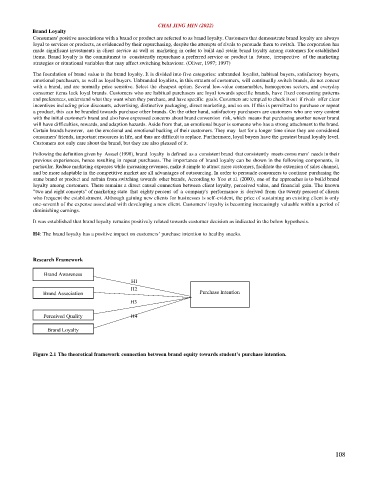
            It was established that brand loyalty remains positively related towards customer decision as indicated in the below hypothesis.

            H4: The brand loyalty has a positive impact on customers’ purchase intention to healthy snacks.


            Research Framework


            Figure 2.1 The theoretical framework connection between brand equity towards student’s purchase intention.


                                                                                                                108

