


Page 135 - MARSIUM'21 COMP OF PAPER
P. 135
CHAI JING MIN (2022)


               4.2 Normality Test
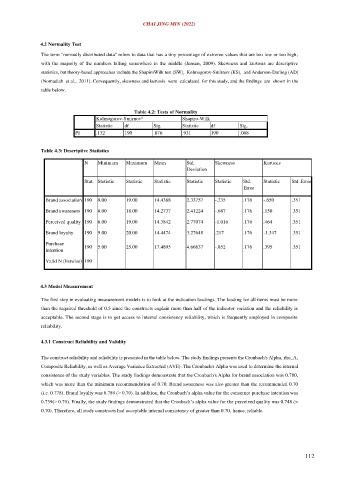
               The term "normally distributed data" refers to data that has a tiny percentage of extreme values that are too low or too high,
               with  the  majority  of the  numbers  falling  somewhere  in  the  middle  (Jensen,  2009).  Skewness  and  kurtosis  are  descriptive
               statistics, but theory-based approaches include the ShapiroWilk test (SW),  Kolmogorov-Smirnov (KS),  and Anderson-Darling (AD)
               (Nornadiah  et al.,  2011). Consequently, skewness and kurtosis  were  calculated  for this study, and the findings  are  shown in the
               table below.


                                                Table 4.2: Tests of Normality
                                                   a
                                   Kolmogorov-Smirnov            Shapiro-Wilk
                                   Statistic   df      Sig.      Statistic   df      Sig.
                           PI      .132      190       .076      .931      190       .068

               Table 4.3: Descriptive Statistics

                               N   Minimum   Maximum   Mean        Std.      Skewness         Kurtosis
                                                                   Deviation

                               Stat.  Statistic   Statistic   Statistic   Statistic   Statistic   Std.   Statistic   Std. Error
                                                                                       Error
                 Brand association  190  9.00   19.00   14.4368    2.33757   -.235    .176    -.650     .351

                 Brand awareness  190  8.00   18.00    14.2737     2.41224   -.687    .176    .150      .351
                 Perceived quality  190  6.00   19.00   14.3842    2.77074   -1.016   .176    .464      .351
                 Brand loyalty   190  9.00   20.00     14.4474     3.27648   .217     .176    -1.347    .351

                 Purchase      190  5.00     25.00     17.4895     4.66637   -.852    .176    .395      .351
                 intention

                 Valid N (listwise)  190


               4.3 Model Measurement

               The first step in evaluating measurement models is to look at the indication loadings. The loading for all items must be more
               than the required threshold of 0.5 since the constructs explain more than half of the indicator variation and the reliability is
               acceptable. The second stage is to get access to internal consistency reliability, which is frequently employed in composite
               reliability.

               4.3.1 Construct Reliability and Validity

               The construct reliability and reliability is presented in the table below. The study findings presents the Cronbach's Alpha, rho_A,
               Composite Reliability, as well as Average Variance Extracted (AVE). The Cronbach's Alpha was used to determine the internal
               consistence of the study variables. The study findings demonstrate that the Cronbach's Alpha for brand association was 0.780,
               which was more than the minimum recommendation of 0.70. Brand awareness was also greater than the recommended 0.70
               (i.e. 0.778). Brand loyalty was 0.789 (> 0.70). In addition, the Cronbach’s alpha value for the consumer purchase intention was
               0.739(> 0.70). Finally, the study findings demonstrated that the Cronbach’s alpha value for the perceived quality was 0.748 (>
               0.70). Therefore, all study constructs had acceptable internal consistency of greater than 0.70, hence, reliable.


                                                                                                            112

