


Page 156 - MARSIUM'21 COMP OF PAPER
P. 156
134                                        Dayang Permai (2022)

                  Audience emotion             5               0.709                    Moderate
                  Perception values            5               0.727                    Moderate
                  Attitude                     5               0.619                    Moderate
                  Culture                      5               0.732                    Moderate
                  Advertisement content        5               0.721                    Moderate

            According to Robert & Richard (2008)'s outcome indicator, all variables utilised in this preliminary test had a coefficient size of 0.7 to
            0.79. As a result, with 30 sample sizes, it has a reasonable alpha coefficient size for all independent and dependent variables.

            4.3.2  Actual Survey

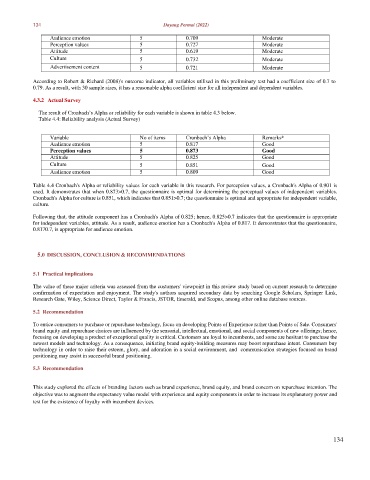
              The result of Cronbach’s Alpha or reliability for each variable is shown in table 4.3 below.
              Table 4.4: Reliability analysis (Actual Survey)


                  Variable                     No of items     Cronbach’s Alpha         Remarks*
                  Audience emotion             5               0.817                    Good
                  Perception values            5               0.873                    Good
                  Attitude                     5               0.825                    Good
                  Culture                      5               0.851                    Good
                  Audience emotion             5               0.809                    Good

            Table 4.4 Cronbach's Alpha or reliability values for each variable in this research. For perception values, a Cronbach's Alpha of 0.901 is
            used. It demonstrates that when 0.873>0.7, the questionnaire is optimal for determining the perceptual values of independent  variables.
            Cronbach's Alpha for culture is 0.851, which indicates that 0.851>0.7; the questionnaire is optimal and appropriate for independent variable,
            culture.

            Following that, the attitude component has a Cronbach's Alpha of 0.825; hence, 0.825>0.7 indicates that the questionnaire is appropriate
            for independent variables, attitude. As a result, audience emotion has a Cronbach's Alpha of 0.817. It demonstrates that the questionnaire,
            0.8170.7, is appropriate for audience emotion.


              5.0  DISCUSSION, CONCLUSION & RECOMMENDATIONS


            5.1  Practical implications

            The value of these major criteria was assessed from the customers' viewpoint in this review study based on current research to determine
            confirmation of expectation and enjoyment. The study's authors acquired secondary data by searching Google Scholars, Springer Link,
            Research Gate, Wiley, Science Direct, Taylor & Francis, JSTOR, Emerald, and Scopus, among other online database sources.

            5.2  Recommendation

            To entice consumers to purchase or repurchase technology, focus on developing Points of Experience rather than Points of Sale. Consumers'
            brand equity and repurchase choices are influenced by the sensorial, intellectual, emotional, and social components of new offerings; hence,
            focusing on developing a product of exceptional quality is critical. Customers are loyal to incumbents, and some are hesitant to purchase the
            newest models and technology. As a consequence, initiating brand equity-building measures may boost repurchase intent. Consumers buy
            technology in order to raise their esteem, glory, and adoration in a social environment, and  communication strategies focused on brand
            positioning may assist in successful brand positioning.

            5.3  Recommendation


            This study explored the effects of branding factors such as brand experience, brand equity, and brand concern on repurchase intention. The
            objective was to augment the expectancy value model with experience and equity components in order to increase its explanatory power and
            test for the existence of loyalty with incumbent devices.


                                                                                                               134

