


Page 152 - MARSIUM'21 COMP OF PAPER
P. 152
130                                        Dayang Permai (2022)

             2.3 RESEARCH FRAMEWORK MODEL


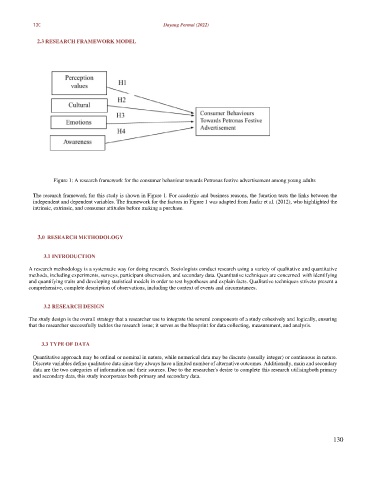
                   Figure 1: A research framework for the consumer behaviour towards Petronas festive advertisement among young adults

            The research framework for this study is shown in Figure 1. For academic and business reasons, the function tests the links between the
            independent and dependent variables. The framework for the factors in Figure 1 was adapted from Jaafar et al. (2012), who highlighted the
            intrinsic, extrinsic, and consumer attitudes before making a purchase.


              3.0  RESEARCH METHODOLOGY


               3.1 INTRODUCTION

           A research methodology is a systematic way for doing research. Sociologists conduct research using a variety of qualitative and quantitative
           methods, including experiments, surveys, participant observation, and secondary data. Quantitative techniques are concerned  with identifying
           and quantifying traits and developing statistical models in order to test hypotheses and explain facts. Qualitative techniques strive to present a
           comprehensive, complete description of observations, including the context of events and circumstances.


               3.2 RESEARCH DESIGN

           The study design is the overall strategy that a researcher use to integrate the several components of a study cohesively and logically, ensuring
           that the researcher successfully tackles the research issue; it serves as the blueprint for data collecting, measurement, and analysis.


               3.3 TYPE OF DATA

            Quantitative approach may be ordinal or nominal in nature, while numerical data may be discrete (usually integer) or continuous in nature.
            Discrete variables define qualitative data since they always have a limited number of alternative outcomes. Additionally, main and secondary
            data are the two categories of information and their sources. Due to the researcher's desire to complete this research utilising both primary
            and secondary data, this study incorporates both primary and secondary data.


                                                                                                               130

