


Page 155 - MARSIUM'21 COMP OF PAPER
P. 155
133                                        Dayang Permai (2022)

            This research surveyed 100 respondents to determine the components that contribute to the analysis of Petronas Festive Advertisement as an
            audience emotion influence on young adults among Kampung Baru residents. Additionally, the researcher determines the sample size in this
            study using simple random sampling. Thirty respondents were employed in the pilot test for the reliability test. Utilizing this basic random
            selection strategy makes it easier to elicit responses to the questionnaire. Once collecting data among all questionnaires administered, the
            researcher may do frequency distribution analysis, descriptive analysis, and reliability analysis on the collected data. Additionally, if the
            researcher wishes to ascertain the existence of a relationship between the independent variables, he or she may use regression and correlation
            analysis.


              4.0  DATA ANALYSIS PLAN


            4.1  INTRODUCTION

            All data are taken from 100 surveys sent randomly through Google form and WhatsApp application, and the analysis of the findings is
            provided  in  the  next  part  in  the  form of  tables.  The Statistical  Package  for Social Sciences  (SPSS)  software  was  used  to  analyse  the
            respondents' responses. The data indicate that respondents are capable of responding to all research questions, therefore accomplishing the
            study's goals. Additionally, the results indicate whether the hypotheses will be evaluated.


            4.2  DESCRIPTIVE ANALYSIS

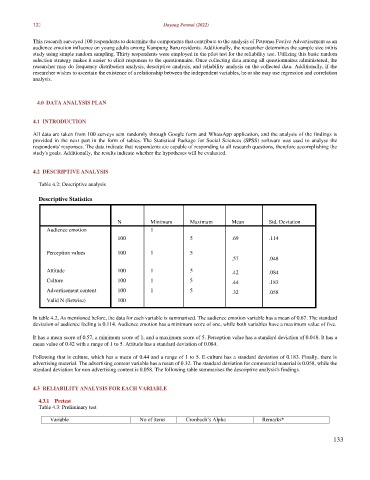
              Table 4.2: Descriptive analysis

              Descriptive Statistics


                                        N          Minimum      Maximum       Mean        Std. Deviation
                Audience emotion                   1
                                        100                     5             .69         .114


                Perception values       100        1            5
                                                                              .57         .048
                Attitude                100        1            5             .42         .084
                Culture                 100        1            5             .44         .183
                Advertisement content   100        1            5             .32         .058
                Valid N (listwise)      100


            In table 4.2, As mentioned before, the data for each variable is summarised. The audience emotion variable has a mean of 0.67. The standard
            deviation of audience feeling is 0.114. Audience emotion has a minimum score of one, while both variables have a maximum value of five.

            It has a mean score of 0.57, a minimum score of 1, and a maximum score of 5. Perception value has a standard deviation of 0.048. It has a
            mean value of 0.42 with a range of 1 to 5. Attitude has a standard deviation of 0.084.

            Following that is culture, which has a mean of 0.44 and a range of 1 to 5. E-culture has a standard deviation of 0.183. Finally, there is
            advertising material. The advertising content variable has a mean of 0.32. The standard deviation for commercial material is 0.058, while the
            standard deviation for non-advertising content is 0.058. The following table summarises the descriptive analysis's findings.


            4.3  RELIABILITY ANALYSIS FOR EACH VARIABLE

              4.3.1  Pretest
              Table 4.3: Preliminary test

                  Variable                     No of items     Cronbach’s Alpha         Remarks*


                                                                                                               133

