


Page 14 - ssr_16
P. 14
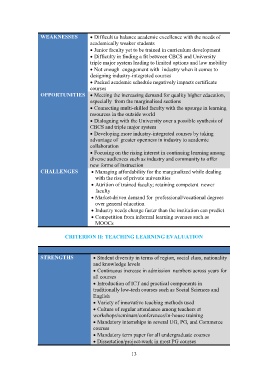
WEAKNESSES Difficult to balance academic excellence with the needs of
academically weaker students
Junior faculty yet to be trained in curriculum development
Difficulty in finding a fit between CBCS and University
triple major system leading to limited options and low mobility
Not enough engagement with industry when it comes to
designing industry-integrated courses
Packed academic schedule negatively impacts certificate
courses
OPPORTUNITIES Meeting the increasing demand for quality higher education,
especially from the marginalised sections
Connecting multi-skilled faculty with the upsurge in learning
resources in the outside world
Dialoguing with the University over a possible synthesis of
CBCS and triple major system
Developing more industry-integrated courses by taking
advantage of greater openness in industry to academic
collaboration
Focusing on the rising interest in continuing learning among
diverse audiences such as industry and community to offer
new forms of instruction
CHALLENGES Managing affordability for the marginalized while dealing
with the rise of private universities
Attrition of trained faculty; retaining competent newer
faculty
Market-driven demand for professional/vocational degrees
over general education
Industry needs change faster than the institution can predict
Competition from informal learning avenues such as
MOOCs
CRITERION II: TEACHING LEARNING EVALUATION
STRENGTHS Student diversity in terms of region, social class, nationality
and knowledge levels
Continuous increase in admission numbers across years for
all courses
Introduction of ICT and practical components in
traditionally low-tech courses such as Social Sciences and
English
Variety of innovative teaching methods used
Culture of regular attendance among teachers at
workshops/seminars/conferences/in-house training
Mandatory internships in several UG, PG, and Commerce
courses
Mandatory term paper for all undergraduate courses
Dissertation/project-work in most PG courses
13

