


Page 12 - Account 10
P. 12
Resolution (Prastab)


          6.   Introduction
              An organization may face a number of difficulties
          and  problems  in  the  regular  course  of  its  operation.
          It should tackle them in such a way that they can be
          democratically  solved.  Similarly,  a  number  of  plans
          and policies and some additional programmes are also,
          to be approved and executed in the same way. For such
          all purposes, they are to be systematically presented in
          a meeting or conference for discussion and decision. As
          such, a resolution is written form of proposal i.e. subject
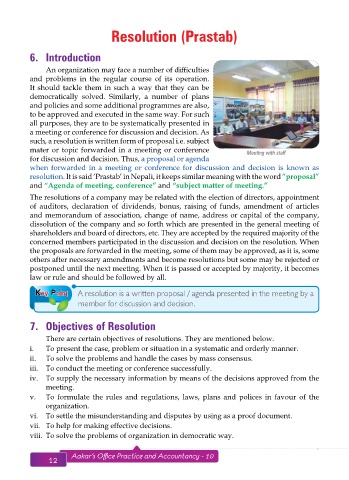
          mater or topic forwarded in a meeting or conference          Meeting with staff
          for discussion and decision. Thus, a proposal or agenda
          when  forwarded  in  a  meeting  or  conference  for  discussion  and  decision  is  known  as
          resolution. It is said ‘Prastab’ in Nepali, it keeps similar meaning with the word “proposal”
          and “Agenda of meeting, conference” and “subject matter of meeting.”
          The resolutions of a company may be related with the election of directors, appointment
          of  auditors,  declaration  of  dividends,  bonus,  raising  of  funds,  amendment  of  articles
          and memorandum of association, change of name, address or capital of the company,
          dissolution of the company and so forth which are presented in the general meeting of
          shareholders and board of directors, etc. They are accepted by the required majority of the
          concerned members participated in the discussion and decision on the resolution. When
          the proposals are forwarded in the meeting, some of them may be approved, as it is, some
          others after necessary amendments and become resolutions but some may be rejected or
          postponed until the next meeting. When it is passed or accepted by majority, it becomes
          law or rule and should be followed by all.

           Key Point   A resolution is a written proposal / agenda presented in the meeting by a
                       member for discussion and decision.

          7.  Objectives of Resolution

              There are certain objectives of resolutions. They are mentioned below.
          i.    To present the case, problem or situation in a systematic and orderly manner.
          ii.   To solve the problems and handle the cases by mass consensus.
          iii.   To conduct the meeting or conference successfully.
          iv.   To supply the necessary information by means of the decisions approved from the
              meeting.
          v.   To  formulate  the  rules  and  regulations,  laws,  plans  and  polices  in  favour  of  the
              organization.
          vi.   To settle the misunderstanding and disputes by using as a proof document.
          vii.  To help for making effective decisions.
          viii.  To solve the problems of organization in democratic way.


               12    Aakar’s Office Practice and Accountancy - 10                                                                                          Office Procedures           13

