


Page 215 - Account 10
P. 215
6.  Rules for Debit and Credit
              The New Accounting System of Government of Nepal is completely based on the
          principle of double entry book-keeping system. Thus, the rules for debit and credit are
          exactly the same as studied under the book keeping in the class nine. Here, the rules/
          principles for debit and credit are discussed pointwise under two approaches.

          i.  Account approach
              It classifies the heading which may be involved in various financial transactions, into
          three accounts. The accounts, involved in the transactions, examples and the respective
          rules/principles for debit and credit are discussed below:

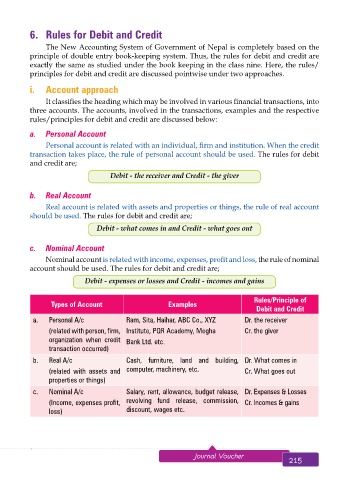
          a.  Personal Account
              Personal account is related with an individual, firm and institution. When the credit
          transaction takes place, the rule of personal account should be used. The rules for debit
          and credit are;
                                Debit - the receiver and Credit - the giver


          b.  Real Account
              Real account is related with assets and properties or things, the rule of real account
          should be used. The rules for debit and credit are;

                             Debit - what comes in and Credit - what goes out

          c.   Nominal Account
              Nominal account is related with income, expenses, profit and loss, the rule of nominal
          account should be used. The rules for debit and credit are;
                         Debit - expenses or losses and Credit - incomes and gains

                                                                         Rules/Principle of
                Types of Account                 Examples
                                                                          Debit and Credit
          a.   Personal A/c          Ram, Sita, Haihar, ABC Co., XYZ   Dr. the receiver
               (related with person, firm,  Institute, PQR Academy, Megha  Cr. the giver
               organization when credit   Bank Ltd. etc.
               transaction occurred)
          b.   Real A/c              Cash,  furniture,  land  and  building,  Dr. What comes in
               (related  with assets  and   computer, machinery, etc.  Cr. What goes out
               properties or things)
          c.   Nominal A/c           Salary, rent, allowance, budget release,  Dr. Expenses & Losses
               (Income, expenses profit,   revolving fund release,  commission,   Cr. Incomes & gains
               loss)                 discount, wages etc.


 214  Aakar’s Office Practice and Accountancy - 10      Journal Voucher            215

