


Page 174 - Health, Population and Environment Education 9
P. 174
h.  The public places should be made horn free zones.
          i.   There should be plantation on both sides of road.
          j.   Random explosion of fire crackers should be banned.

          k.  The vehicles should be repaired time and again.
          l.   People should be made aware about causes and effects of sound pollution.
          m.  Strict rules and regulations should be formulated and implemented to control sound
              pollution.

           Activity: 4
           Visit your locality and observe the types of pollution in the surrounding. Make a list of
           effects and ways to control them by concerned authority. Discuss them in class.


            7.4  Management of Solid Wastes

          People utilize various materials in day to day life. Food, clothes, metals, glass, rubber,
          etc. are widely used. After their use, some are thrown as wastes. They are thrown here
          and there in the surroundings.  A large amount of wastes are produced from industries,
          markets,  hospitals,  workshops,  offices,  schools,  etc.  Random  discharge  of  wastes
          produced from different sources litters the surrounding, pollutes environment, spreads
          many diseases, affects land and water ecosystem, makes the area unsuitable for living. So,
          it is most essential to manage solid wastes.
          Management of solid wastes means adoption of various activities that include collection,
          transfer, treatment, burial, burning and disposal of solid wastes in a systematic way.


          Introduction to solid wastes
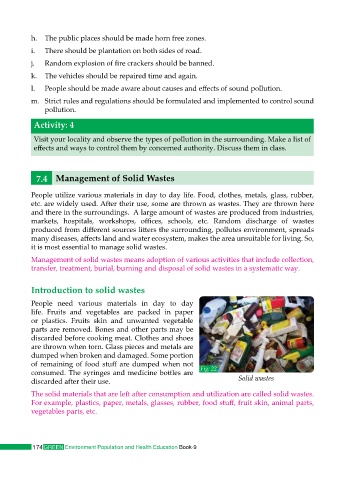
          People need various materials in day to day
          life. Fruits and  vegetables are packed  in paper
          or plastics. Fruits  skin and unwanted vegetable
          parts are removed. Bones and other parts may be
          discarded before cooking meat. Clothes and shoes
          are thrown when torn. Glass pieces and metals are
          dumped when broken and damaged. Some portion
          of remaining of food stuff are dumped when not   Fig: 22
          consumed. The syringes and medicine bottles are
          discarded after their use.                                  Solid wastes

          The solid materials that are left after consumption and utilization are called solid wastes.
          For example, plastics, paper, metals, glasses, rubber, food stuff, fruit skin, animal parts,
          vegetables parts, etc.


          174  GREEN Environment Population and Health Education Book-9

