


Page 204 - Health, Population and Environment Education 9
P. 204
proper nutrition for mother and child. Hence, safe motherhood ranges from pregnancy
          till 42 days after delivery. In the context of Nepal, there is lack of health services and
          people are ignorant about health care services. So, the safe motherhood is quite poor.
          Majority of females have first marriage at the age of (15-19) years. More than 50%, three
          out of five females deliver in home and about 15% females deliver a baby without health
          check ups even once with medical practitioners. There is high maternal mortality rate as
          well. Nearby three females die out of 1000 deliveries.

          c.  Infant and child health care

          It is most essential to care a pregnant lady for delivery of a healthy baby. Even after birth,
          there should be proper care of infant. Special attention should be given for sanitation,
          cleanliness, breast feeding, clothing as well as sleep and rest of infant. The infant should be
          given appropriate nutrition and immunization as well. As a result, there can be reduction
          of infant and child mortality rate.

          d.  Unsafe abortion and treatment of its consequences

          The termination of growing foetus before birth either
          naturally or artificially is called abortion. There can
          be termination of growing foetus naturally  during
          accident,  infection  in  uterus,  defirmity  of  uterus,
          carrying heavy loads,  excessive stress  and anxiety,
          falling down etc. It is called as miscarriage. There can
          be termination of growing foetus artificially by using
          medicines or with the support of medical personnel. It
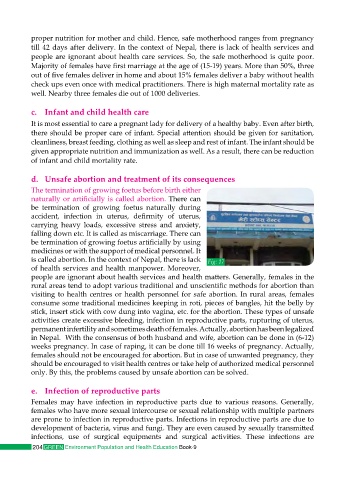
          is called abortion. In the context of Nepal, there is lack   Fig: 17
          of health services and health manpower. Moreover,
          people are ignorant about health services and health matters. Generally, females in the
          rural areas tend to adopt various traditional and unscientific methods for abortion than
          visiting to health centres or health personnel for safe abortion. In rural areas, females
          consume some traditional medicines keeping in roti, pieces of bangles, hit the belly by
          stick, insert stick with cow dung into vagina, etc. for the abortion. These types of unsafe
          activities create excessive bleeding, infection in reproductive parts, rupturing of uterus,
          permanent infertility and sometimes death of females. Actually, abortion has been legalized
          in Nepal.  With the consensus of both husband and wife, abortion can be done in (6-12)
          weeks pregnancy. In case of raping, it can be done till 16 weeks of pregnancy. Actually,
          females should not be encouraged for abortion. But in case of unwanted pregnancy, they
          should be encouraged to visit health centres or take help of authorized medical personnel
          only. By this, the problems caused by unsafe abortion can be solved.

          e.  Infection of reproductive parts
          Females  may have infection in reproductive parts due to various  reasons.  Generally,
          females who have more sexual intercourse or sexual relationship with multiple partners
          are prone to infection in reproductive parts. Infections in reproductive parts are due to
          development of bacteria, virus and fungi. They are even caused by sexually transmitted
          infections,  use  of  surgical  equipments  and  surgical  activities.  These  infections  are
          204  GREEN Environment Population and Health Education Book-9

