


Page 206 - Health, Population and Environment Education 9
P. 206
A.  Male Reproductive System

          The network of all organs, their structure and functions which are related for the
          reproduction process in males is called male reproductive system.

          Male reproductive system is designed in such a way that one organ produces numerous
          minute spermatozoa (sperm cells). Another stores them and nourishes them. Then another
          organ transfers them into female reproductive organ.
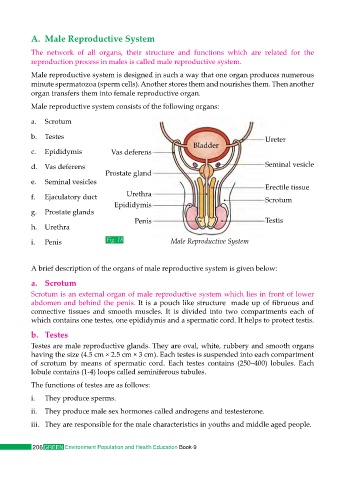
          Male reproductive system consists of the following organs:

          a.  Scrotum

          b.  Testes                                                          Ureter
                                                         Bladder
          c.  Epididymis         Vas deferens
          d.  Vas deferens                                                    Seminal vesicle
                                Prostate gland
          e.  Seminal vesicles
                                                                              Erectile tissue
          f.   Ejaculatory duct       Urethra                                 Scrotum
                                  Epididymis
          g.  Prostate glands
                                        Penis                                 Testis
          h.  Urethra

          i.  Penis             Fig: 18            Male Reproductive System


          A brief description of the organs of male reproductive system is given below:
          a.  Scrotum
          Scrotum is an external organ of male reproductive system which lies in front of lower
          abdomen and behind the penis. It is a pouch like structure  made up of fibruous and
          connective tissues  and smooth  muscles.  It is divided  into two compartments  each of
          which contains one testes, one epididymis and a spermatic cord. It helps to protect testis.

          b.  Testes
          Testes are male reproductive glands. They are oval, white, rubbery and smooth organs
          having the size (4.5 cm × 2.5 cm × 3 cm). Each testes is suspended into each compartment
          of scrotum by means of spermatic cord. Each testes contains (250–400) lobules. Each
          lobule contains (1-4) loops called seminiferous tubules.

          The functions of testes are as follows:
          i.   They produce sperms.

          ii.  They produce male sex hormones called androgens and testesterone.
          iii.  They are responsible for the male characteristics in youths and middle aged people.


          206  GREEN Environment Population and Health Education Book-9

