


Page 244 - Health, Population and Environment Education 9
P. 244
and hazard. Disaster risk is therefore considered as the combination of the severity and
          frequency of a hazard the number of people and assets exposed to the hazard, and their
          vulnerability to damage.

          The key  to understanding disaster risk is by  recognizing that  disasters are indicators
          of development failures, meaning that disaster risk is a measure of the sustainability of
          development. Hazard, vulnerability and exposure are influenced by a number of risk
          drivers, including poverty and inequality badly planned and managed urban and regional
          development, climate change and environmental degradation.

          Disaster and disaster management
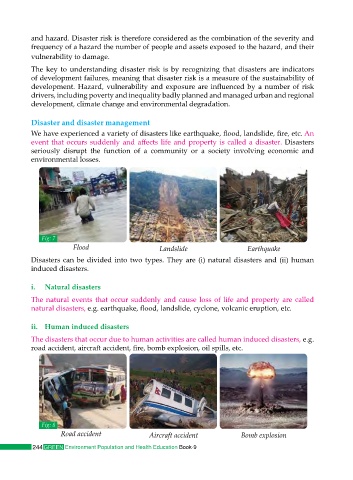
          We have experienced a variety of disasters like earthquake, flood, landslide, fire, etc. An
          event that occurs suddenly and affects life and property is called a disaster. Disasters
          seriously disrupt the function of a community or a society involving economic  and
          environmental losses.


             Fig: 7
                      Flood                    Landslide                 Earthquake
          Disasters can be divided into two types. They are (i) natural disasters and (ii) human
          induced disasters.

          i.   Natural disasters

          The natural events that occur suddenly and cause loss of life and property are called
          natural disasters, e.g. earthquake, flood, landslide, cyclone, volcanic eruption, etc.

          ii.  Human induced disasters

          The disasters that occur due to human activities are called human induced disasters, e.g.
          road accident, aircraft accident, fire, bomb explosion, oil spills, etc.


             Fig: 8
                   Road accident            Aircraft accident          Bomb explosion
          244  GREEN Environment Population and Health Education Book-9

