


Page 247 - Health, Population and Environment Education 9
P. 247
Mitigating measures for flood and landslide
            i.   We should not panic.
            ii.  We should stay in a safe be afraid.

            iii.  We should not try to cross the flooded river.
            iv.  We should help the affected people.
            v.  We should inform seniors or rescue team if we see a blocked river or stream.

            vi.  We should give first aid to victims and rush them to hospital for treatment.
            vii.  We should manage the dead bodies properly after flood and landslide.


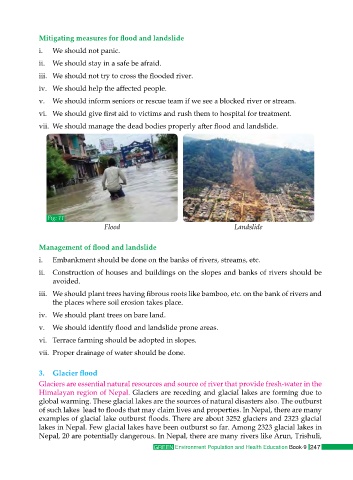
               Fig: 11
                               Flood                                 Landslide


            Management of flood and landslide
            i.   Embankment should be done on the banks of rivers, streams, etc.
            ii.  Construction of houses and buildings on the slopes and banks of rivers should be
                avoided.
            iii.  We should plant trees having fibrous roots like bamboo, etc. on the bank of rivers and
                the places where soil erosion takes place.
            iv.  We should plant trees on bare land.
            v.  We should identify flood and landslide prone areas.

            vi.  Terrace farming should be adopted in slopes.
            vii.  Proper drainage of water should be done.


            3.  Glacier flood
            Glaciers are essential natural resources and source of river that provide fresh-water in the
            Himalayan region of Nepal. Glaciers are receding and glacial lakes are forming due to
            global warming. These glacial lakes are the sources of natural disasters also. The outburst
            of such lakes  lead to floods that may claim lives and properties. In Nepal, there are many
            examples of glacial lake outburst floods. There are about 3252 glaciers and 2323 glacial
            lakes in Nepal. Few glacial lakes have been outburst so far. Among 2323 glacial lakes in
            Nepal, 20 are potentially dangerous. In Nepal, there are many rivers like Arun, Trishuli,
                                              GREEN  Environment Population and Health Education Book-9 247

