


Page 25 - Health, Population and Environment Education 9
P. 25
Secondary data
            The data which are collected from other sources than the primary sources of data are
            called secondary data. They are also called second hand data.
            The sources of primary data are explained below.


            i.  Census
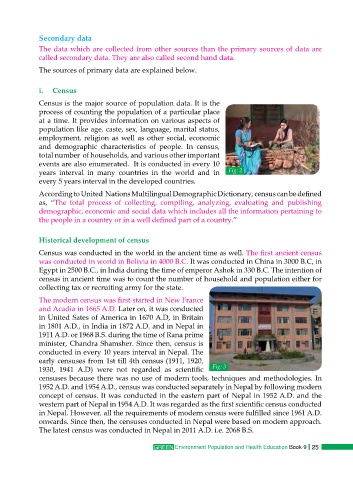
            Census is the major source of population data. It is the
            process of counting the population of a particular place
            at a time. It provides information on various aspects of
            population like age, caste, sex, language, marital status,
            employment, religion as well as other social, economic
            and demographic characteristics of people. In census,
            total number  of households, and various other important
            events are also enumerated.  It is conducted in every 10
            years interval in many countries in the world and in   Fig: 2
            every 5 years interval in the developed countries.
            According to United  Nations Multilingual Demographic Dictionary, census can be defined
            as,  “The total process  of collecting, compiling, analyzing, evaluating and publishing
            demographic, economic and social data which includes all the information pertaining to
            the people in a country or in a well defined part of a country.”


            Historical development of census
            Census was conducted in the world in the ancient time as well. The first ancient census
            was conducted in world in Bolivia in 4000 B.C. It was conducted in China in 3000 B.C, in
            Egypt in 2500 B.C., in India during the time of emperor Ashok in 330 B.C. The intention of
            census in ancient time was to count the number of household and population either for
            collecting tax or recruiting army for the state.

            The modern census was first started in New France
            and Acadia in 1665 A.D. Later on, it was conducted
            in United Sates of America in 1670 A.D, in Britain
            in 1801 A.D., in India in 1872 A.D. and in Nepal in
            1911 A.D. or 1968 B.S. during the time of Rana prime
            minister, Chandra Shamsher. Since then, census is
            conducted in every 10 years interval in Nepal. The
            early censuses from 1st till 4th census (1911, 1920,
            1930,  1941  A.D)  were  not  regarded  as  scientific   Fig: 3
            censuses because there was no use of modern tools, techniques and methodologies. In
            1952 A.D. and 1954 A.D., census was conducted separately in Nepal by following modern
            concept of census. It was conducted in the eastern part of Nepal in 1952 A.D. and the
            western part of Nepal in 1954 A.D. It was regarded as the first scientific census conducted
            in Nepal. However, all the requirements of modern census were fulfilled since 1961 A.D.
            onwards. Since then, the censuses conducted in Nepal were based on modern approach.
            The latest census was conducted in Nepal in 2011 A.D. i.e. 2068 B.S.

                                              GREEN  Environment Population and Health Education Book-9 25

