


Page 28 - Health, Population and Environment Education 9
P. 28
Bureau of Statistics (CBS) conducted a pilot project on vital registration in Kathmandu
          valley in 2021 B.S., i.e. 1964 A.D. However, it took long time to start formal vital registration
          in Nepal. In 2033 B.S., i.e. 1976 A.D, the office of Registrar General was established under
          the Ministry of Home and Panchayat. Initially, vital registration started only in 10 districts
          in Nepal in 2035 B.S., i.e. 1978 A.D. It started in all the districts of Nepal only from 1st
          Baisakh, 2047 B.S.
          Vital registration is done in the concerned municipality or village council office. People
          need to fill in forms for the registration of vital events. Then, the local registrar provides
          event registration certificates, i.e. birth certificate, death certificate, marriage certificate
          and  migration  certificate.  These  certificates  are  very  important  for  various  legal  and
          administrative purposes. Birth certificate is mandatory to get student admitted in school,
          to receive citizenship card, to appear in district level examination in school, etc. Death
          certificate is required to transfer parental properties, to claim insurance policies, bank
          deposits, etc. Marriage certificate is needed to apply visa as dependent to go abroad, to
          be eligible legally for husband’s properties. Migration certificate is required to get certain
          benefits provided at the local level or by the government.
          Vital registration is very important for the nation. It provides information about social
          and demographic characteristics of people. It is reliable and valid source of population
          data. It shows the population situation. It helps the policy makers, economists, politicians
          and others to perform social activities. Moreover, it provides important information for
          the government to launch different development plannings.


          iii.  Administrative records
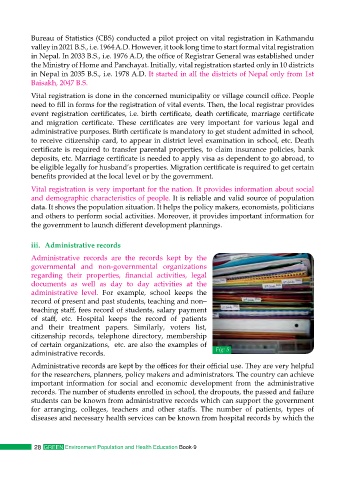
          Administrative records  are the records  kept by the
          governmental and  non-governmental organizations
          regarding  their  properties,  financial  activities,  legal
          documents  as well as  day to day activities at the
          administrative level.  For example, school keeps the
          record of present and past students, teaching and non–
          teaching staff, fees record of students, salary payment
          of  staff,  etc.  Hospital  keeps  the  record  of  patients
          and  their treatment papers. Similarly,  voters  list,
          citizenship records, telephone directory, membership
          of certain organizations,  etc. are also the examples of   Fig: 5
          administrative records.

          Administrative records are kept by the offices for their official use. They are very helpful
          for the researchers, planners, policy makers and administrators. The country can achieve
          important  information for social and economic development from the  administrative
          records. The number of students enrolled in school, the dropouts, the passed and failure
          students can be known from administrative records which can support the government
          for  arranging,  colleges,  teachers  and  other  staffs.  The  number  of  patients,  types  of
          diseases and necessary health services can be known from hospital records by which the


           28  GREEN Environment Population and Health Education Book-9

