


Page 32 - Health, Population and Environment Education 9
P. 32
bring up children. Hence, the parents are not likely to bear more children in a nuclear
          family.


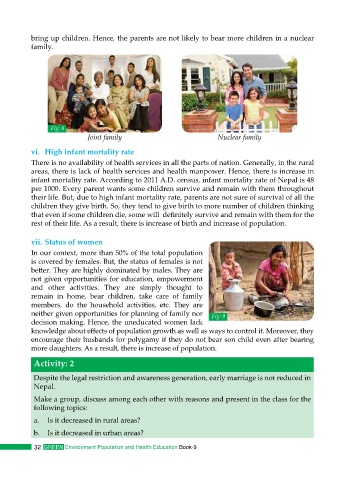
                Fig: 8
                           Joint family                         Nuclear family

          vi.  High infant mortality rate
          There is no availability of health services in all the parts of nation. Generally, in the rural
          areas, there is lack of health services and health manpower. Hence, there is increase in
          infant mortality rate. According to 2011 A.D. census, infant mortality rate of Nepal is 48
          per 1000. Every parent wants some children survive and remain with them throughout
          their life. But, due to high infant mortality rate, parents are not sure of survival of all the
          children they give birth. So, they tend to give birth to more number of children thinking
          that even if some children die, some will  definitely survive and remain with them for the
          rest of their life. As a result, there is increase of birth and increase of population.

          vii. Status of women
          In our context, more than 50% of the total population
          is covered by females. But, the status of females is not
          better. They are highly dominated by males. They are
          not given opportunities for education, empowerment
          and other activities. They are simply thought to
          remain in home, bear children, take care of family
          members, do the household activities, etc. They are
          neither given opportunities for planning of family nor   Fig: 9
          decision making. Hence, the uneducated women lack
          knowledge about effects of population growth as well as ways to control it. Moreover, they
          encourage their husbands for polygamy if they do not bear son child even after bearing
          more daughters. As a result, there is increase of population.

           Activity: 2

           Despite the legal restriction and awareness generation, early marriage is not reduced in
           Nepal.

           Make a group, discuss among each other with reasons and present in the class for the
           following topics:
           a.  Is it decreased in rural areas?

           b.  Is it decreased in urban areas?
           32  GREEN Environment Population and Health Education Book-9

