


Page 34 - Health, Population and Environment Education 9
P. 34
labourers to work in the field. They cannot get any other labourers as honest as their
          children and in free. Hence, they bear more children. But, people involved in other
          occupation like services, business, teaching, etc. remain busy and have less time to bring
          up their children. Therefore, they want to bear less children.

          iv.  Insurance for future
          People want to bear many children for their security and good life during the old age.
          People cannot work during old age. They need someone to take care of them. They have
          to depend on their children. People think that when they bear more children, even if
          many children do not take care of them, at least one or two will take care of them in the
          old age. Due to this type of thinking, people want to bear more children. Ultimately, there
          is increase of population growth.

          c.  Environmental factors
          Those factors which are related with environment and environment matters, they are
          called  environment factors. Climate is one of the environmental factors. The  climatic
          condition of a place affects the birth of children. Generally, females in hot places become
          mature faster and have early starting of menstruation than the females in cold places. As
          a result, there is extension of fertility period in females in hot places. Hence, females in
          hot places give birth to more children than the females in cold places. In our context, terai
          region has hot climate and mountain region has cold climate. The females in terai region
          become mature faster, have early development of reproductive organs and early starting
          of menstruation cycle than the females in mountain region. Hence, it is seen that females
          in terai region give birth to more children than the females in mountain region.
          Factors affecting death
          Death is the natural factor of population change. Death in inevitable part of our life. It
          decreases the population in a place. According to WHO, death can be defined as, “The
          permanent  disappearance of all the  evidences of life.” People in Nepal  are surviving
          more. Their life expectancy has been extended a lot in comparison to last (20 – 30) years. It
          is actually due to availability of health services, health manpower, improvement in health
          sector, invention of medicines, control of diseases, awareness on health education, etc.
          There are various factors affecting death. They are described below:

          a.  Social factors

          i.  Illiteracy
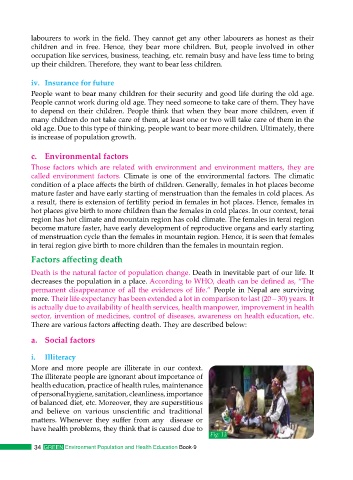
          More  and  more  people are illiterate in our  context.
          The illiterate people are ignorant about importance of
          health education, practice of health rules, maintenance
          of personal hygiene, sanitation, cleanliness, importance
          of balanced diet, etc. Moreover, they are superstitious
          and  believe  on  various  unscientific  and  traditional
          matters.  Whenever  they  suffer  from  any    disease  or
          have health problems, they think that is caused due to
                                                              Fig: 13
           34  GREEN Environment Population and Health Education Book-9

