


Page 41 - Health, Population and Environment Education 9
P. 41
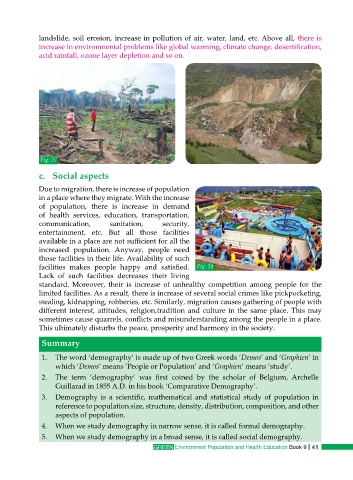
landslide, soil erosion, increase in pollution of air, water, land, etc. Above all, there is
            increase in environmental problems like global warming, climate change, desertification,
            acid rainfall, ozone layer depletion and so on.


             Fig: 27

            c.  Social aspects
            Due to migration, there is increase of population
            in a place where they migrate. With the increase
            of population, there is increase in demand
            of health services, education, transportation,
            communication,       sanitation,    security,
            entertainment,  etc. But all those facilities
            available in a place are not sufficient for all the
            increased population.  Anyway, people need
            those facilities in their life. Availability of such
            facilities  makes  people  happy  and  satisfied.  Fig: 28
            Lack  of such  facilities  decreases  their living
            standard.  Moreover, their is  increase  of  unhealthy competition among  people for the
            limited facilities. As a result, there is increase of several social crimes like pickpocketing,
            stealing, kidnapping, robberies, etc. Similarly, migration causes gathering of people with
            different interest, attitudes, religion,tradition and culture in the same place. This may
            sometimes cause quarrels, conflicts and misunderstanding among the people in a place.
            This ultimately disturbs the peace, prosperity and harmony in the society.
             Summary

             1.  The word ‘demography’ is made up of two Greek words ‘Demos’ and ‘Graphien’ in
                 which ‘Demos’ means ‘People or Population’ and ‘Graphien’ means ‘study’.
             2.  The  term  ‘demography’  was  first  coined  by  the  scholar  of  Belgium,  Archelle
                 Guillarad in 1855 A.D. in his book ‘Comparative Demography’.
             3.  Demography  is  a  scientific,  mathematical  and  statistical  study  of  population  in
                 reference to population size, structure, density, distribution, composition, and other
                 aspects of population.
             4.  When we study demography in narrow sense, it is called formal demography.
             5.  When we study demography in a broad sense, it is called social demography.
                                              GREEN  Environment Population and Health Education Book-9 41

