


Page 110 - 9 teachers social book 9 @ 2077 ctp_Neat
P. 110
Peace Culture in Nepal

           Peace is inevitable for an individual, a
           community, a society and a nation. As
           we know that peace culture minimizes
           misunderstanding prevailing at all
           levels,  Nepal  and  Nepalese  people
           faced one decade long conflict in the
           country where there was no peace, no
           security of life and a property. People
           used to live in terror.  When  Maoist
           and  Seven  Party  Alliance  came  to
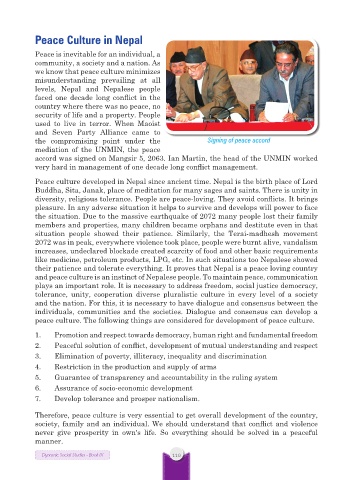
           the compromising  point under  the                Signing of peace accord
           mediation of the UNMIN, the peace
           accord was signed on Mangsir 5, 2063. Ian Martin, the head of the UNMIN worked
           very hard in management of one decade long conflict management.
           Peace culture developed in Nepal since ancient time. Nepal is the birth place of Lord
           Buddha, Sita, Janak, place of meditation for many sages and saints. There is unity in
           diversity, religious tolerance. People are peace-loving. They avoid conflicts. It brings
           pleasure. In any adverse situation it helps to survive and develops will power to face
           the situation. Due to the massive earthquake of 2072 many people lost their family
           members and properties, many children became orphans and destitute even in that
           situation people showed  their  patience. Similarly,  the Terai-madhesh movement
           2072 was in peak, everywhere violence took place, people were burnt alive, vandalism
           increases, undeclared blockade created scarcity of food and other basic requirements
           like medicine, petroleum products, LPG, etc. In such situations too Nepalese showed
           their patience and tolerate everything. It proves that Nepal is a peace loving country
           and peace culture is an instinct of Nepalese people. To maintain peace, communication
           plays an important role. It is necessary to address freedom, social justice democracy,
           tolerance,  unity, cooperation  diverse  pluralistic  culture  in  every level  of  a society
           and the nation. For this, it is necessary to have dialogue and consensus between the
           individuals, communities and the societies. Dialogue and consensus can develop a
           peace culture. The following things are considered for development of peace culture.
           1.    Promotion and respect towards democracy, human right and fundamental freedom
           2.    Peaceful solution of conflict, development of mutual understanding and respect
           3.    Elimination of poverty, illiteracy, inequality and discrimination
           4.    Restriction in the production and supply of arms
           5.    Guarantee of transparency and accountability in the ruling system
           6.    Assurance of socio-economic development
           7.    Develop tolerance and prosper nationalism.

           Therefore, peace culture is very essential to get overall development of the country,
           society, family and an individual. We should understand that conflict and violence
           never  give  prosperity  in  own's  life.  So  everything  should  be  solved  in  a  peaceful
           manner.
             Dynamic Social Studies - Book IX      110

