


Page 283 - 9 teachers social book 9 @ 2077 ctp_Neat
P. 283
Judicial System

          Our  ancestors followed judicial system based on
          religious  practice  in  the  society.  Rulers  were  the
          followers  of  Hinduism.  So,  it  was  mainly  guided
          by the  Hinduism.  There  were  not  fair  judicial
          system during ancient period. The judgement were
          influenced  by  the  castes  also.  Comparison  to  the
          other castes the Brahmins used to get very low
          degree of punishment.

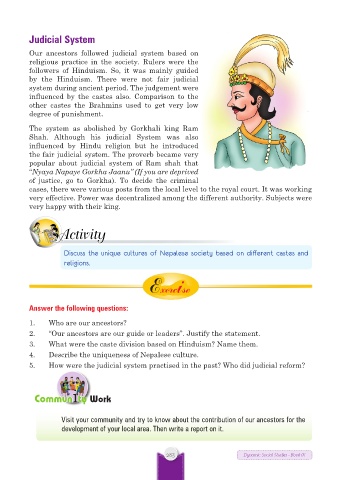
          The system as abolished by Gorkhali  king Ram
          Shah. Although his judicial System was also
          influenced  by  Hindu  religion  but  he  introduced
          the fair judicial system. The proverb became very
          popular about judicial  system of Ram shah  that
          “Nyaya Napaye Gorkha Jaanu” (If you are deprived
          of justice, go to Gorkha).  To decide the criminal
          cases, there were various posts from the local level to the royal court. It was working
          very effective. Power was decentralized among the different authority. Subjects were
          very happy with their king.


                  Activity


                    Discuss the unique cultures of Nepalese society based on different castes and
                    religions.


                                            Exercise


          Answer the following questions:

          1.   Who are our ancestors?
          2.   “Our ancestors are our guide or leaders”. Justify the statement.
          3.   What were the caste division based on Hinduism? Name them.
          4.   Describe the uniqueness of Nepalese culture.
          5.   How were the judicial system practised in the past? Who did judicial reform?


           Community Work


                   Visit your community and try to know about the contribution of our ancestors for the
                   development of your local area. Then write a report on it.


                                                 283                    Dynamic Social Studies - Book IX

