


Page 145 - Social Studies 7
P. 145
and Tirahut(Mithila) in the South. After him the kingdom was separated into
          his sons and daughter. Ratna Malla got Kantipur, Raya Malla got Bhaktapur or
          Bhadgaon, Rana Malla got Banepa. His daughter got Patan. In this way there
          were separate rules in the valley kingdom. Despite they belonged to same clan
          there was no mutual love and cooperation. So, they became weak and Prithivi
          Narayan Shah captured the Kathmandu valley.


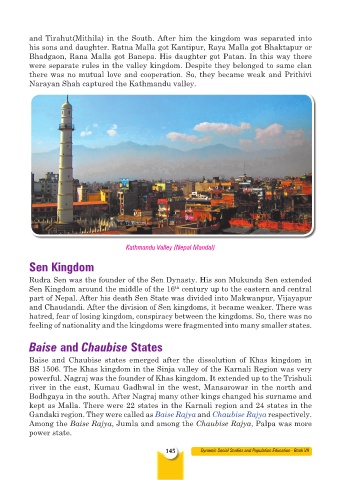
                                      Kathmandu Valley (Nepal Mandal)

          Sen Kingdom

          Rudra Sen was the founder of the Sen Dynasty. His son Mukunda Sen extended
                                                    th
          Sen Kingdom around the middle of the 16  century up to the eastern and central
          part of Nepal. After his death Sen State was divided into Makwanpur, Vijayapur
          and Chaudandi. After the division of Sen kingdoms, it became weaker. There was
          hatred, fear of losing kingdom, conspiracy between the kingdoms. So, there was no
          feeling of nationality and the kingdoms were fragmented into many smaller states.


          Baise and Chaubise States

          Baise  and  Chaubise  states  emerged  after  the  dissolution  of  Khas  kingdom  in
          BS 1506. The Khas kingdom in the Sinja valley of the Karnali Region was very
          powerful. Nagraj was the founder of Khas kingdom. It extended up to the Trishuli
          river in the east, Kumau Gadhwal in the west, Mansarowar in the north and
          Bodhgaya in the south. After Nagraj many other kings changed his surname and
          kept as Malla. There were 22 states in the Karnali region and 24 states in the
          Gandaki region. They were called as Baise Rajya and Chaubise Rajya respectively.
          Among the Baise Rajya, Jumla and among the Chaubise Rajya, Palpa was more
          power state.

                                                 145       Dynamic Social Studies and Population Education - Book VII

