


Page 33 - Social Studies 7
P. 33
Lesson      Infrastructure of Development: Transportation
          1.6


                                     Nepal has total road network of 80,078 km. That includes 26,935 km
                         FACTS       roads constructed and being maintained by Department of Roads(DOR)
                      to Understand  and 53,143 km road constructed by the government local bodies. Of
                                     the total 53,143 km local rural road, only 1,697 km has been black-
                                     topped, 38,898km is earthen road and 12,548km has been gravelled.
                                                                 Source: Himalayan News Service
                                                                           Article Published on
                                                                             July 13, 2015 AD


          Infrastructures refer to the basic facilities service and installations needed for
          the functioning  of a community or society. Transportation is also one of the
          infrastructures of development. It is the act of transporting or the state of being
          transported often of people, goods, etc. In other words it is the movement of people
          and goods from one place to another. Transport infrastructure consists of roads
          railways, airways, waterways, canals and pipelines and terminals. Automobiles,
          bicycles  buses,  trains,  trunks,  helicopters,  aircraft,  etc.  are  the  means  of
          transportation used for travelling.
          Transport is one of the most important infrastructures of development as it enables
          trade between persons, which is essential for the development of civilizations. It
          facilitates trade, exchange and travel. In the ancient time, people used to travel
          through bullock carts, horses, camel, etc. but now humans can also travel in air
          as well as space.

          Means of transportation

          There  are  mainly  five  important  means  of  transportation.  They  are  explained
          briefly.

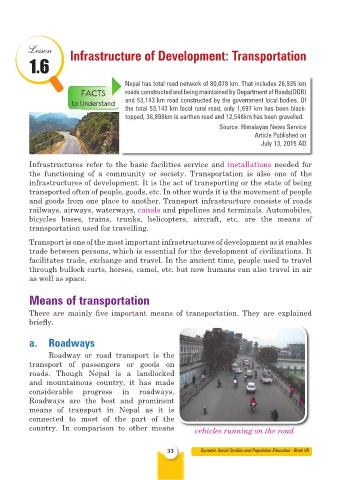
          a.  Roadways

               Roadway or road transport is the
          transport of passengers  or  goods on
          roads.  Though Nepal is  a landlocked
          and mountainous  country,  it  has  made
          considerable   progress    in  roadways.
          Roadways are  the  best and prominent
          means of transport in Nepal as it is
          connected to most of the part  of the
          country. In comparison to other means           vehicles running on the road


                                                  33       Dynamic Social Studies and Population Education - Book VII

