


Page 30 - Social Studies 7
P. 30
The  major  Peaks  are  Mt.  Kanjirowa
           (6,  612  m),  Mt.  Kanti  (6,859  m),  Mt.
           Gorakh (6,088 m), Mt. Changla (6,563),
           etc.  Rara National Park and Shey-
           Phoksundo National Park are two major
           parks  and also  tourist  destinations.
           Other  central of attractions  are Rara
           lake, Shey- Phoksundo lake etc. Badi
           Malika, Deuti Bajai and Chandannath
           temple are some religious sites of this
           region. There are airports in Surkhet,
           and Jumla too.

           Major  Ethnic  groups are the Bhotes,
           the Magars, the Tharus, including the
           Thakuris, the Kamis, the Dashnamis/
           Sanyasis, the Brahmins, the Chhetris,
           the Dholis  etc.  The  literacy  rate is  62.77%. The  major sources  of  income  are
           agriculture, tourism and natural resources.

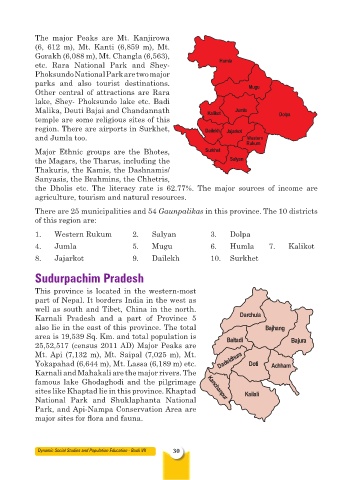
           There are 25 municipalities and 54 Gaunpalikas in this province. The 10 districts
           of this region are:

           1.    Western Rukum          2.    Salyan          3.    Dolpa
           4.    Jumla                  5.    Mugu            6.    Humla      7.    Kalikot
           8.    Jajarkot               9.    Dailekh         10.   Surkhet

           Sudurpachim Pradesh

           This province is located in the western-most
           part of Nepal. It borders India in the west as
           well as south and Tibet, China in the north.
           Karnali  Pradesh  and  a  part  of  Province  5
           also lie in the east of this province. The total
           area is 19,539 Sq. Km. and total population is
           25,52,517 (census 2011 AD) Major Peaks are
           Mt. Api (7,132 m), Mt. Saipal (7,025 m), Mt.
           Yokapahad (6,644 m), Mt. Lassa (6,189 m) etc.
           Karnali and Mahakali are the major rivers. The
           famous  lake  Ghodaghodi and the  pilgrimage
           sites like Khaptad lie in this province. Khaptad
           National  Park  and Shuklaphanta  National
           Park, and Api-Nampa Conservation Area are
           major sites for flora and fauna.


            Dynamic Social Studies and Population Education - Book VII  30

