


Page 32 - Math 7
P. 32
Number Systems in Diff erent Bases

           2.7  Quinary  number system
           We have already discussed on  denary (or decimal) number system as the base
           ten system and binary number system as the base two system. Likewise, quinary
           (or pental) number system is known as the base five system. In this system, we
           use only five digits: 0, 1, 2, 3, and 4. The numbers in the quinary system can be
           expressed in the power of 5. For example:

                                                       1
                     1
                                               2
           14 = 1 u 5  + 4 u 5q,      321 = 3 u 5  + 2 u 5  + 1 u 5q,   and so on.
           For the proper identification of quinary numbers, they are written with their base 5
           in the suffix. Some examples are 34 , 102 , 31240 , etc.
                                               5    5       5
           2.8  Conversion of quinary numbers to decimal numbers
           To covert a quinary number into decimal number, it is expanded in the power of 5.
           Then, by simplifying the expanded form of the quinary number, we get a decimal

           number. For example:
           (i) 32  = 3 u 5  + 2 u 5q        (ii) 1234  = 1 u 5  + 2 u 5  + 3 u 5  + 4 u 5q
                           1
                                                                               1
                                                                      2
                                                              3
                5                                   5
                    = 3 u 5 + 2 u 1                    = 1 u 125 + 2 u 25 + 3 u 5 + 4 u 1
                    = 15 + 2  = 17                     = 125 + 50 + 15 + 4 = 194
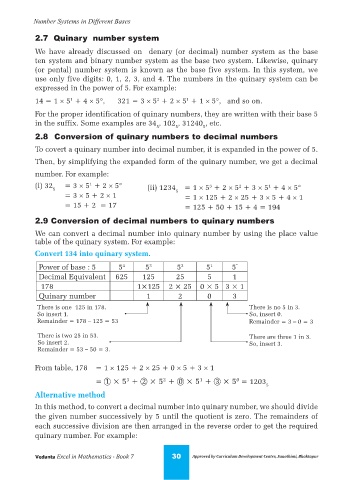
           2.9 Conversion of decimal numbers to quinary numbers
           We can convert a decimal number into quinary number by using the place value
           table of the quinary system. For example:
           Convert 134 into quinary system.

            Power of base : 5      5 4     5 3      5 2      5 1    5 °
            Decimal Equivalent     625    125       25       5       1
             178                         1×125    2 × 25   0 × 5 3 × 1
            Quinary number                  1        2       0       3
            There is one  125 in 178.                                    There is no 5 in 3.
            So insert 1.                                                 So, insert 0.
            Remainder = 178 – 125 = 53                                   Remainder = 3 – 0 = 3
            There is two 25 in 53.                                       There are three 1 in 3.
            So insert 2.                                                 So, insert 3.
            Remainder = 53 – 50 = 3.

           From table, 178  = 1 u 125 + 2 u 25 + 0 u 5 + 3 u 1
                                                           1
                                                2
                                                                      0
                                      3
                             = 1 × 5  +  2 × 5  +  0 × 5  +  3 × 5  = 1203    5
           Alternative method
           In this method, to convert a decimal number into quinary number, we should divide
           the given number successively by 5 until the quotient is zero. The remainders of
           each successive division are then arranged in the reverse order to get the required
           quinary number. For example:


           Vedanta Excel in Mathematics - Book 7   30    Approved by Curriculum Development Centre, Sanothimi, Bhaktapur

